Question
The path difference between two interference waves at a point on a screen is $11.5\, times$ the wavelength. The point is

Answer

Odd multiple of $\lambda/2$ produces dark fringe.

Need a full question paper?

Generate a complete, print-ready paper with questions like this in minutes — across 16+ boards, with answer keys.
Start Generating Free

Similar questions

In a transistor the base is very lightly doped as compared to the emitter because by doing so
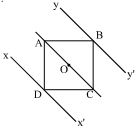
Let $I_1, I_2$ and $I_3$ be the moment of inertia of a uniform square plate about axes $AOC, xDx'$ and $yBy'$ respectively as shown in the figure. The moments of inertia of the plate $I_1 : I_2 : I_3$ are in the ratio.
During an adiabatic process, the pressure of a gas is found to be proportional to the cube of its absolute temperature. The ratio of $\frac{C_p}{C_v}$ for the gas is:
A copper disc of radius $0.1\, m$ rotates about its centre with $10$ revolutions per second in a uniform magnetic field of $0.1$ Tesla. The emf induced across the radius of the disc is
A concave mirror gives an image three times as large as the object placed at a distance of $20cm$ from it. For the image to be real, the focal length should be......$cm$
Water rises to height $'h'$ in capillary tube. If the length of capillary tube above the surface of water is made less than $'h'$, then
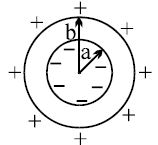
$IAn$ empty thick conducting shell of inner radius $a$ and outer radius $b$ is shown in figure.If it is observed that the inner face of the shell carries a uniform charge density $-\sigma$ and the surface carries a uniform charge density $ '\sigma '$

Choose the correct statement related to the potential of the shell in absence of $q_B$
A signal of $100 \,THz$ frequency can be transmitted with maximum efficiency by
A coil of cross-sectional area  $A$ having $n$  turns is placed in a uniform magnetic field $B.$  When it is rotated with an angular velocity $\omega ,$  the maximum $e.m.f.$  induced in the coil will be
Two identical particles of mass $1\, {kg}$ each go round a circle of radius ${R}$, under the action of their mutual gravitational attraction. The angular speed of each particle is :