$IAn$ empty thick conducting shell of inner radius $a$ and outer radius $b$ is shown in figure.If it is observed that the inner face of the shell carries a uniform charge density $-\sigma$ and the surface carries a uniform charge density $ '\sigma '$
Choose the correct statement related to the potential of the shell in absence of $q_B$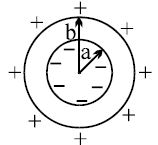
Diffcult


Download our appand get started for free
Experience the future of education. Simply download our apps or reach out to us for more information. Let's shape the future of learning together!No signup needed.*
Similar Questions
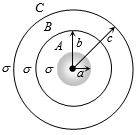
- 1Three concentric metallic shells $A, B$ and $C$ of radii $a, b$ and $c (a < b < c)$ have surface charge densities $\sigma ,\, - \sigma $ and $\sigma $ respectively. then ${V_A}$ and ${V_B}$View Solution
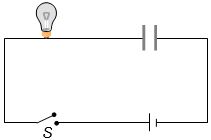
- 2A light bulb, a capacitor and a battery are connected together as shown here, with switch $S$ initially open. When the switch $S$ is closed, which one of the following is trueView Solution
- 3Two identical capacitors have same capacitance $C$. One of them is charged to the potential $\mathrm{V}$ and other to the potential $2 \mathrm{~V}$. The negative ends of both are connected together. When the positive ends are also joined together, the decrease in energy of the combined system is :View Solution
- 4Two charge $ + \,q$ and $ - \,q$ are situated at a certain distance. At the point exactly midway between themView Solution
- 5The capacity of a parallel plate condenser is $10\,\mu F$ without dielectric. Dielectric of constant $2$ is used to fill half the distance between the plates, the new capacitance in $\mu F$ isView Solution
- 6The radius of a charged metal sphere $(R)$ is $10\,cm$ and its potential is $300\,V$. Find the charge density on the surface of the sphereView Solution
- 7Three long concentric conducting cylindrical shells have radii $R, 2R$ and $2\sqrt 2 $ $ R$ . Inner and outer shells are connected to each other. The capacitance across middle and inner shells per unit length is:View Solution
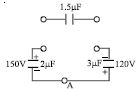
- 8Two capacitors of $2$ $\mu F$ and $3$ $\mu F$ are charged to $150$ $volt$ and $120$ $volt$ respectively. The plates of capacitor are connected as shown in the figure. A discharged capacitor of capacity $1.5$ $\mu F$ falls to the free ends of the wire. ThenView Solution
- 9The energy and capacity of a charged parallel plate capacitor are $U$ and $C$ respectively. Now a dielectric slab of $\in _r = 6$ is inserted in it then energy and capacity becomes (Assume charge on plates remains constant)View Solution
- 10A parallel plate capacitor of capacitance $C$ has spacing $d$ between two plates having area $A$. The region between the plates is filled with $N$ dielectric layers, parallel to its plates, each with thickness $\delta=\frac{ d }{ N }$. The dielectric constant of the $m ^{\text {th }}$ layer is $K _{ m }= K \left(1+\frac{ m }{ N }\right)$. For a very large $N \left(>10^3\right)$, the capacitance $C$ is $\alpha\left(\frac{ K \varepsilon_0 A }{ d \;ln 2}\right)$. The value of $\alpha$ will be. . . . . . . .View Solution
[ $\epsilon_0$ is the permittivity of free space]