MCQ
The peak voltage of the ac source is equal to:
  • A
    the $rms$ value of the ac source
  • $\sqrt{2}$ times the $rms$ value of the $ac$ source
  • C
    $\frac{1}{\sqrt{2}}$ times the $rms$ value of the $ac$ source
  • D
    the value of voltage supplied to the circuit
Answer

Correct option: B.
$\sqrt{2}$ times the $rms$ value of the $ac$ source
b
Peak voltage is $\sqrt{2}$ times rms voltages in ac.

Need a full question paper?

Generate a complete, print-ready paper with questions like this in minutes — across 16+ boards, with answer keys.

Start Generating Free

Similar questions

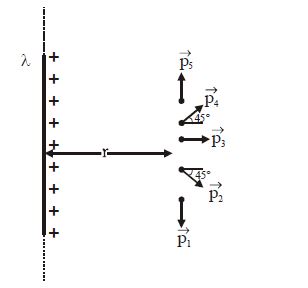
Five identical small electric dipoles are placed at a distance $r$ from an infinitely long straight wire carrying a uniform charge density $\lambda$.If they experience force of magnitude $F_1$, $F_2$, $F_3$, $F_4$ and $F_5$ respectively then
The mean free path of electrons in a metal is $4 \times 10^{-8} \;m$. The electric field which can give on an average $2 \;eV$ energy to an electron in the metal will be in units of $V / m$
Two spheres $P$ and $Q$, of same colour having radii $8\;cm$ and $2\;cm$ are maintained at temperatures ${127^o}C$ and ${527^o}C$ respectively. The ratio of energy radiated by $P$ and $Q$ is
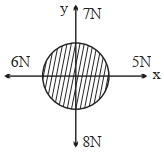
For a free body diagram shown in the figure, the four forces are applied in the ' $x$ ' and ' $y$ ' directions. What additional force must be applied and at what angle with positive $x$-axis so that the net acceleration of body is zero?
A beam of light converges at a point $P$. Now a lens is placed in the path of the convergent beam $12\, cm$ from $P$. At what point does the beam converge if the lens is a concave lens of focal length $16\,cm$ ?.......$cm$
The force on a charge situated on the axis of a dipole is $F$. If the charge is shifted to double the distance, the new force will be
Six charges are placed at the corner of a regular hexagon as shown. If an electron is placed at its centre $O$, force on it will be:
The mass of a liquid flowing per second per unit area of cross section of a tube is proportional to $P^x$ and $v^y$ , where $P$ is the pressure difference and $v$ is the velocity. Then, the relation between $x$ and $y$ is
A light ray enters a solid glass sphere of refractive index $\mu=\sqrt{3}$ at an angle of incidence $60^{\circ}$. The ray is both reflected and refracted at the farther surface of the sphere. The angle (in degrees) between the reflected and refracted rays at this surface is......
There is a uniform electric field of strength ${10^3}\,V/m$ along $y$-axis. A body of mass $1\,g$ and charge $10^{-6}\,C$ is projected into the field from origin along the positive $x$-axis with a velocity $10\,m/s$. Its speed in $m/s$ after $10\,s$ is (Neglect gravitation)