MCQ
The percentage increase in the speed of transverse waves produced in a stretched string if the tension is increased by $4\, \%$, will be ......... $\%$
  • A
    $1$
  • $2$
  • C
    $0$
  • D
    $4$

Answer

Correct option: B.
$2$
b
$v =\sqrt{\frac{ T }{\mu}}$

$\frac{\Delta V }{ V }=\frac{1}{2} \frac{\Delta T }{ T }$

Need a full question paper?

Generate a complete, print-ready paper with questions like this in minutes — across 16+ boards, with answer keys.
Start Generating Free

Similar questions

In rear$-$wheel drive cars, the engine rotates the rear wheels and the front wheels rotate only because the car moves. If such a car accelerates on a horizontal road, the friction:
A particle of mass $'m'$ moving with a velocity $v$ strikes a stationary particle of mass $2m$ and sticks to it. The speed of the system will be:
The spiders and insects move and run about on the surface of water without sinking because
The percentage errors in the measurement of mass and speed are $2\%$ and $3\%$ respectively. How much will be the maximum error in the estimation of the kinetic energy obtained by measuring mass and speed  ......... $\%$
Suppose that the speed of sound in air at a given temperature is $400 m/sec$. An engine blows a whistle at $1200 Hz$ frequency. It is approaching an observer at the speed of $100 m/sec$. What is the apparent frequency as heard by the observer .... $Hz$
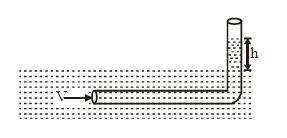
An  $L-$ shaped glass tube is just immersed in flowing water towards tube as shown. If speed of water current is $V,$  then the height  $h$  upto which water rises will be
There is a following relationship between the distance covered $x$ and time $t$ of a particle is : $x=\mathrm{At}+\mathrm{Bt}^2$. In this dimensions of A and B are :
Two particles start simultaneously from the same point and move along two straight lines, one with uniform velocity $v$ and other with a uniform acceleration $a$. If $\alpha$ is the angle between the lines of motion of two particles, then the least value of relative velocity will be at time given by
A wheel has angular acceleration of $3 .0\, rad/sec^2$ and an initial angular speed of $2.00\, rad/sec.$ In a time of $2\, sec$ it has rotated through an angle (in radian) of 
The kinetic energy of a particle executing $S.H.M.$ is $16\, J$ when it is at its mean position. If the mass of the particle is $0.32 \,kg$, then what is the maximum velocity of the particle ..... $m/s$