MCQ
The periodic function $\text{f(t)}=\text{A}\sin(\omega\text{t})$ repeats itself with periodic function of:
  • $2\pi$
  • B
    $3\pi$
  • C
    $\pi$
  • D
    $\frac{\pi}{2}$

Answer

Correct option: A.
$2\pi$
A periodic function repeats itself after a time period $T.$ and $\text{f(t) = f(t + T)}$ As $\sin(\omega\text{t}+2\omega\pi)$
$\therefore$ Period of function is

Need a full question paper?

Generate a complete, print-ready paper with questions like this in minutes — across 16+ boards, with answer keys.
Start Generating Free

Similar questions

A bimetallic strip is made of aluminium and steel $(\alpha_\text{At}>\alpha_{\text{steel}}).$ On heatinh, the strip will:
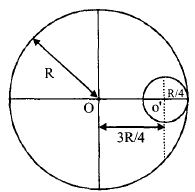
A circular hole of radius $\frac{R}{4}$ is made in a thin uniform disc having mass $M$ and radius $R$, as shown in figure. The moment of inertia of the remaining portion of the disc about an axis passing through the point $O$ and perpendicular to the plane of the disc is
Consider a spherical body, one third of its volume is filled with a liquid which has contact angle zero with the surface of sphere. If this sphere (along with liquid) is taken to gravity free space then shape of liquid inside sphere will look like
A $20 \mathrm{~cm}$ long string, having a mass of $1.0 \mathrm{~g}$, is fixed at both the ends. The tension in the string is $0.5 \mathrm{~N}$. The string is set into vibrations using an external vibrator of frequency $100 \mathrm{~Hz}$. Find the separation (in $cm$) between the successive nodes on the string.
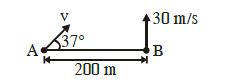
Two particles $A$ and $B$ are moving in horizontal plane as shown in figure at $t = 0$ , then time after which $A$ will catch $B$ will be.......$s$
A cylindrical tank has a hole of $1 cm^2$ in its bottom. If the water is allowed to flow into the tank from a tube above it at the rate of $70 cm^3/sec$. then the maximum height up to which water can rise in the tank is  .......... $cm$
During which of the following thermodynamic process represented by $P V$ diagram the heat energy absorbed by system may be equal to area under $P V$ graph?
The $SI$ unit of a physical quantity is pascal-second. The dimensional formula of this quantity will be ..............
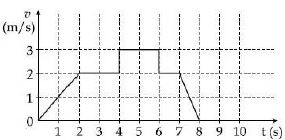
A particle starts from the origin at time $t = 0$ and moves along the positive $x-$ axis. The graph of velocity with respect to time is shown in figure. What is the position of the particle at time $t = 5\,s$ ?.........$m$
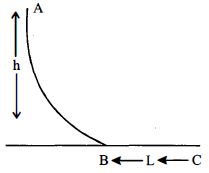
A small ball of mass $m$ starts at a point $A$ with speed $v_0$ and moves along a frictionless track $AB$ as shown. The track $BC$ has coefficient of friction $\mu $. The ball comes to stop at $C$ after travelling a distance $L$ which is