MCQ
The periodic time of a communication satellite is ......... $hours$
  • A
    $6$
  • B
    $12$
  • C
    $18$
  • $24$

Answer

Correct option: D.
$24$
d
(d) A geostationary satellite (having time period of $24\, hr$) is used for communication

Need a full question paper?

Generate a complete, print-ready paper with questions like this in minutes — across 16+ boards, with answer keys.
Start Generating Free

Similar questions

If a long spring is stretched by $0.02\, m$, its potential energy is $U$. If the spring is stretched by $0.1\, m$ then its potential energy will be
A bullet of mass $5\, g$, travelling with a speed of $210$ $m / s ,$ strikes a fixed wooden target. One half of its kinetic energy is converted into heat in the bullet while the other half is converted into heat in the wood. The rise of temperature of the bullet if the specific heat of its material is $0.030\, cal /\left( g -{ }^{\circ} C \right)$ $\left(1\, cal =4.2 \times 10^{7}\, ergs \right)$ close to$.......^oC$
A hospital uses an ultrasonic scanner to locate tumours in a tissue. The operating frequency of scanner is $4.2MHz.$ The speed of sound in the tissue is $1.7\ km s^{-1}$. The wavelength of sound in the tissue is close to:
A ball of mass $m$ moving with velocity in collides elastically with wall and rebounds. The change in momentum of the ball will be:
Two equal forces ($P$ each) act at a point inclined to each other at an angle of $120^°$. The magnitude of their resultant is
Hanging in a spring m the period of oscillation of the mass is T. Oscillations are made by cutting the spring in half and hanging double the mass on it. Now the period of oscillation will be :
$SI$ unit of pressure is
The distance $s$ travelled by a particle in time $t$ is $s=u t-\frac{1}{2} \,g t^{2}$. The initial velocity of the particle was measured to be $u=1.11 \pm 0.01 \,m / s$ and the time interval of the experiment was $t=1.01 \pm 0.1 \,s$. The acceleration was taken to be $g=9.8 \pm 0.1 \,m / s ^{2}$. With these measurements, the student estimates the total distance travelled. How should the student report the result?
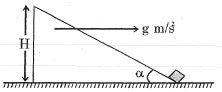
A wedge of height $H$ (fixed) and inclination $\alpha $ (variable) is moving on a smooth horizontal surface with constant acceleration $g\ m/s^2$ . A small block is placed at bottom of incline as shown in figure, slips on the smooth surface of incline . Choose $CORRECT$ statement about time taken by block to reach the top of incline
What is the pressure in $atm$ on a swimmer $10\; m$ below the surface of a lake?