Question
The phase difference between displacement and acceleration of a particle in a simple harmonic motlon is 

Answer

Displacement $(x)$ equation of $SHM$

$x = A \sin (\omega t +\phi)$ $....(1)$

$\frac{ dx }{ dt }= A \omega \cos (\omega t +\phi)$

acceleration $(a)=\frac{d^{2} x}{d t^{2}}$

$a=-\omega^{2} A \sin (\omega t+\phi)$

$a =\omega^{2} A \sin (\omega t +\phi+\pi)$$.....(2)$

from $(1) \;and\;(2),$ phase difference between displacement and acceleration is $\pi .$

Need a full question paper?

Generate a complete, print-ready paper with questions like this in minutes — across 16+ boards, with answer keys.

Start Generating Free

Similar questions

The resonant frequency of a circuit is $f$. If the capacitance is made $4$ times the initial values, then the resonant frequency will become
An electric dipole of moment $\vec P$ is placed in a uniform electric field $\vec E$ such that $\vec P$ points along $\vec E$ . If the dipole is slightly rotated about an axis perpendicular to the plane containing $\vec E$ and $\vec P$ and passing through the centre of the dipole, the dipole executes simple harmonic motion. Consider $I$ to be the moment of inertia of the dipole about the axis of rotation. What is the time period of such oscillation?
When water is heated from $0$ to $4\,^oC$
The persistence of sound in a room after the source of sound is turned off is called reverberation. The measure of reverberation time is the time required for sound intensity to decrease by $60 \,dB$. It is given that the intensity of sound falls off as $I_0 \exp \left(-c_1 \alpha\right)$ where $I_0$ is the initial intensity, $c_1$ is a dimensionless constant with value $1 / 4$. Here, $\alpha$ is a positive constant which depends on the speed of sound, volume of the room, reverberation time, and the effective absorbing area $A_e$. The value of $A_e$ is the product of absorbing coefficient (with value between $0$ and $1,1$ being a perfect absorber) and the area of the room. For a concert hall of volume $600 \,m ^3$, the value of $A_e$ (in $m ^2$ ) required to give a reverberation time of $1 s$ is closest to (speed of sound in air $=340 \,m / s$ )
A cylindrical steel rod of length $0.10 \,m$ and thermal conductivity $50 \,Wm ^{-1} K ^{-1}$ is welded end to end to copper rod of thermal conductivity $400 \,Wm ^{-1} K ^{-1}$ and of the same area of cross-section but $0.20 \,m$ long. The free end of the steel rod is maintained at $100^{\circ} C$ and that of the copper rod at $0^{\circ} C$. Assuming that the rods are perfectly insulated from the surrounding, the temperature at the junction of the two rods is ................... $^{\circ} C$
A mixture of two moles of hydrogen and one mole of argon gas is taken in a closed container at room temperature. Consider the following two statements

$(i)$  The average kinetic energy of each molecule of $H_2$ and $Ar$ are the same.

$(ii)$  The partial pressure due to argon gas is more than that due to hydrogen gas

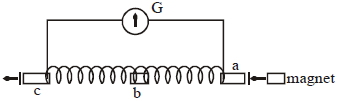
A small bar magnet is moved through a coil at constant speed from one end to the other. Which of the following series of observations wil be seen on the galvanometer $G$ attached across the coil$?$

Three positions shown describe: $(a)$ the magnet's entry $(b)$ magnet is completely inside and $(c)$ magnet's exit.
The self inductance of a straight conductor is
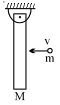
$A$ uniform rod of mass $M$ is hinged at its upper end. $A$ particle of mass $m$ moving horizontally strikes the rod at its mid point elastically. If the particle comes to rest after collision find the value of $M/m =?$
A train moving at a speed of $220\, ms^{-1}$ towards a stationary object, emits a sound of frequency $1000\, Hz$. Some of the sound reaching the object gets reflected back to the train as echo. The frequency of the echo as detected by the driver of the train is .... $ Hz$ (speed of sound in air is $330\, ms^{-1}$)