The persistence of sound in a room after the source of sound is turned off is called reverberation. The measure of reverberation time is the time required for sound intensity to decrease by $60 \,dB$. It is given that the intensity of sound falls off as $I_0 \exp \left(-c_1 \alpha\right)$ where $I_0$ is the initial intensity, $c_1$ is a dimensionless constant with value $1 / 4$. Here, $\alpha$ is a positive constant which depends on the speed of sound, volume of the room, reverberation time, and the effective absorbing area $A_e$. The value of $A_e$ is the product of absorbing coefficient (with value between $0$ and $1,1$ being a perfect absorber) and the area of the room. For a concert hall of volume $600 \,m ^3$, the value of $A_e$ (in $m ^2$ ) required to give a reverberation time of $1 s$ is closest to (speed of sound in air $=340 \,m / s$ )
KVPY 2021, Advanced


Download our appand get started for free
Experience the future of education. Simply download our apps or reach out to us for more information. Let's shape the future of learning together!No signup needed.*
Similar Questions
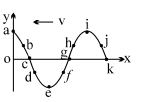
- 1The figure represents the instantaneous picture of a longitudinal harmonic wave travelling along the negative $x$-axis. Identify the correct statement $(s)$ related to the movement of the points shown in the figure. The points of maximum compression areView Solution
- 2A sonometer wire, with a suspended mass of $M = 1\, kg$, is in resonance with a given tuning fork. The apparatus is taken to the moon where the acceleration due to gravity is $(1/6)$ that on earth. To obtain resonance on the moon, the value of $M$ should be ......... $kg$View Solution
- 3A string of length $1\,\,m$ and linear mass density $0.01\,\,kgm^{-1}$ is stretched to a tension of $100\,\,N.$ When both ends of the string are fixed, the three lowest frequencies for standing wave are $f_1, f_2$ and $f_3$. When only one end of the string is fixed, the three lowest frequencies for standing wave are $n_1, n_2$ and $n_3$. ThenView Solution
- 4A wire having a linear mass density $9.0 \times 10^{-4} \;{kg} / {m}$ is stretched between two rigid supports with a tension of $900\; {N}$. The wire resonates at a frequency of $500\;{Hz}$. The next higher frequency at which the same wire resonates is $550\; {Hz}$. The length of the wire is $...... {m}$View Solution
- 5View SolutionAt a certain instant a stationary transverse wave is found to have maximum kinetic energy. The appearance of string at that instant is
- 6View SolutionIf the temperature increases, then what happens to the frequency of the sound produced by the organ pipe
- 7The average density of Earth’s crust $10\ km$ beneath the surface is $2.7\ gm/cm^3$ . The speed of longitudinal seismic waves at that depth is $5.4\ km/s$ . The bulk modulus of Earth’s crust considering its behaviour as fluid at that depth isView Solution
- 8The stationary wave $y = 2a\sin kx\cos \omega \,t$ in a closed organ pipe is the result of the superposition of $y = a\sin (\omega \,t - kx)$ andView Solution
- 9A boy is walking away from a wall towards an observer at a speed of $1\, metre/sec$ and blows a whistle whose frequency is $680 Hz.$ The number of beats heard by the observer per second is (Velocity of sound in air $= 340\, metres/sec$)View Solution
- 10A sound source is moving towards a stationary observer with $1/10$ of the speed of sound. The ratio of apparent to real frequency isView Solution