Question
The phase difference between incident wave and reflected wave is $180^o $  when light ray

Answer

(a)When light reflect from denser surface phase change of $\pi $ occurs.

Need a full question paper?

Generate a complete, print-ready paper with questions like this in minutes — across 16+ boards, with answer keys.

Start Generating Free

Similar questions

If $T$ is the half life of a radioactive material, then the fraction that would remain after a time $\frac{T}{2}$ is
A frog can be deviated in a magnetic field produced by a current in a vertical solenoid placed below the frog. This is possible because the body of the frog behaves as
A wheel having moment of inertia $4 \,kg m ^2$ about its symmetrical axis, rotates at rate of $240 \,rpm$ about it. The torque which can stop the rotation of the wheel in one minute is ............ $Nm$
Which is not true with respect to the cathode rays
A mass $1\, kg$ is suspended by a thread. It is

$(i)\,$ lifted up with an acceleration $4.9\,m/{s^2}$

$(ii) \,$lowered with an acceleration $4.9\,m/{s^2}$.

The ratio of the tensions is
A uniform metal rod of $2\, mm^2$ cross section fixed between two walls is heated from $0\,^oC$ to $20\,^oC$. The coefficient of linear expansion of rod is $12\times10^{-6}/^oC$. Its Young's modulus of elasticity is $10^{11} \,N/m^2$. The energy stored per unit volume of rod will be ....... $J/m^3$
When ${U^{235}}$ is bombarded with one neutron, the fission occurs and the products are three neutrons, $_{36}K{r^{94}}$ and
A large glass slab $(\mu=5 / 3)$ of thickness $8 \mathrm{~cm}$ is placed over a point source of light on a plane surface. It is seen that light emerges out of the top surface of the slab from a circular area of radius $\mathrm{Rcm}$. What is the value of $\mathrm{R}$ ?
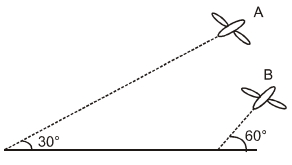
Airplanes $A$ and $B$ are flying with constant velocity in the same vertical plane at angles $30^{\circ}$ and $60^{\circ}$ with respect to the horizontal respectively as shown in figure . The speed of $A$ is $100 \sqrt{3} ms ^{-1}$. At time $t=0$, an observer in A finds $B$ at a distance of $500 \ m$. This observer sees $B$ moving with a constant velocity perpendicular to the line of motion of $A$. If at $t = t _0$, $A$ just escapes being hit by $B , t _0$ in seconds is:
Consider the following two statements $A$ and $B$ and identify the correct choice in the given answers

$A :$ Line spectra is due to atoms in gaseous state

$B :$ Band spectra is due to molecules