Question
The phase difference between two points separated by $0.8 m$ in a wave of frequency is $120 Hz$ is $\frac{\pi }{2}.$ The velocity of wave is .....  $m/s$

Answer

(b) Phase difference $ = \frac{{2\pi }}{\lambda } \times$  path difference

$ \Rightarrow \frac{\pi }{2} = \frac{{2\pi }}{\lambda } \times 0.8$

$ \Rightarrow \lambda = 4 \times 0.8 = 3.2\,m$

Velocity $v = n\lambda $$ = 120 \times 3.2 = 384\,m/s.$

Need a full question paper?

Generate a complete, print-ready paper with questions like this in minutes — across 16+ boards, with answer keys.
Start Generating Free

Similar questions

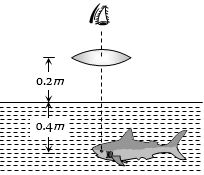
A small fish $0.4\, m$ below the surface of a lake, is viewed through a simple converging lens of focal length $3\, m$. The lens is kept at $0.2\, m$ above the water surface such that fish lies on the optical axis of the lens. The image of the fish seen by observer will be at $\left( {{\mu _{water}} = \frac{4}{3}} \right)$
The second's hand of a watch has length $6\,\, cm$. Speed of end point and magnitude of difference of velocities at two perpendicular positions will be
A whistle sends out $256$ waves in a second. If the whistle approaches the observer with velocity $\frac{1}{3}$ of the velocity of sound in air, the number of waves per second the observer will receive
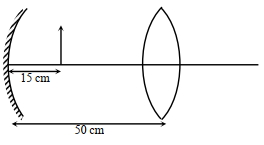
Consider a concave mirror and a convex lens (refractive index $=1.5$ ) of focal length $10 \ cm$ each, separated by a distance of $50 \ cm$ in air (refractive index $=1$ ) as shown in the figure. An object is placed at a distance of $15 \ cm$ from the mirror. Its erect image formed by this combination has magnification $M _1$. When the set- up is kept in a medium of refractive index $7 / 6$, the magnification becomes $M _2$. The magnitude $\left|\frac{ M _2}{ M _1}\right|$ is
The reaction of $50\%$ aq $KOH$ on an equimolar mixture of $4-$ methylbenzaldehyde and formaldehyde followed by acidification gives
Current $i$ is passed as shown in diagram. If radius of the circle is a, then the magnetic flux density at the centre $P$ will be:
If formaldehyde and $KOH$ are heated, then we get
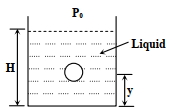
A small spherical monoatomic ideal gas bubble $\left(\gamma=\frac{5}{3}\right)$ is trapped inside a liquid of density $\rho_{\ell}$ (see figure). Assume that the bubble does not exchange any heat with the liquid. The bubble contains n moles of gas. The temperature of the gas when the bubble is at the bottom is $\mathrm{T}_0$, the height of the liquid is $\mathrm{H}$ and the atmospheric pressure is $\mathrm{P}_0$ (Neglect surface tension).

Figure: $Image$

$1.$ As the bubble moves upwards, besides the buoyancy force the following forces are acting on it

$(A)$ Only the force of gravity

$(B)$ The force due to gravity and the force due to the pressure of the liquid

$(C)$ The force due to gravity, the force due to the pressure of the liquid and the force due to viscosity of the liquid

$(D)$ The force due to gravity and the force due to viscosity of the liquid

$2.$ When the gas bubble is at a height $\mathrm{y}$ from the bottom, its temperature is

$(A)$ $\mathrm{T}_0\left(\frac{\mathrm{P}_0+\rho_0 \mathrm{gH}}{\mathrm{P}_0+\rho_t \mathrm{gy}}\right)^{2 / 5}$

$(B)$ $T_0\left(\frac{P_0+\rho_t g(H-y)}{P_0+\rho_t g H}\right)^{2 / 5}$

$(C)$ $\mathrm{T}_0\left(\frac{\mathrm{P}_0+\rho_t \mathrm{gH}}{\mathrm{P}_0+\rho_t \mathrm{gy}}\right)^{3 / 5}$

$(D)$ $T_0\left(\frac{P_0+\rho_t g(H-y)}{P_0+\rho_t g H}\right)^{3 / 5}$

$3.$ The buoyancy force acting on the gas bubble is (Assume $R$ is the universal gas constant)

$(A)$ $\rho_t \mathrm{nRgT}_0 \frac{\left(\mathrm{P}_0+\rho_t \mathrm{gH}\right)^{2 / 5}}{\left(\mathrm{P}_0+\rho_t \mathrm{gy}\right)^{7 / 5}}$

$(B)$ $\frac{\rho_{\ell} \mathrm{nRgT}_0}{\left(\mathrm{P}_0+\rho_{\ell} \mathrm{gH}\right)^{2 / 5}\left[\mathrm{P}_0+\rho_{\ell} \mathrm{g}(\mathrm{H}-\mathrm{y})\right]^{3 / 5}}$

$(C)$ $\rho_t \mathrm{nRgT} \frac{\left(\mathrm{P}_0+\rho_t g \mathrm{H}\right)^{3 / 5}}{\left(\mathrm{P}_0+\rho_t g \mathrm{~g}\right)^{8 / 5}}$

$(D)$ $\frac{\rho_{\ell} \mathrm{nRgT}_0}{\left(\mathrm{P}_0+\rho_{\ell} \mathrm{gH}\right)^{3 / 5}\left[\mathrm{P}_0+\rho_t \mathrm{~g}(\mathrm{H}-\mathrm{y})\right]^{2 / 5}}$

Give the answer question $1,2,$ and $3.$
Two light waves of intensities $I$ and $4I$ superpose at a point with phase difference of $\pi /2$. Calculate resultant amplitude at that point
A body of mass $2 \,kg $ collides with a wall with speed $100\, m/s$ and rebounds with same speed. If the time of contact was $1/50 \,second$, the force exerted on the wall is