MCQ
The phase difference between two points separated by $0.8 m$ in a wave of frequency is $120 Hz$ is $\frac{\pi }{2}.$ The velocity of wave is .....  $m/s$
  • A
    $720$
  • $384$
  • C
    $250$
  • D
    $1 $

Answer

Correct option: B.
$384$
b
(b) Phase difference $ = \frac{{2\pi }}{\lambda } \times$  path difference

$ \Rightarrow \frac{\pi }{2} = \frac{{2\pi }}{\lambda } \times 0.8$

$ \Rightarrow \lambda = 4 \times 0.8 = 3.2\,m$

Velocity $v = n\lambda $$ = 120 \times 3.2 = 384\,m/s.$

Need a full question paper?

Generate a complete, print-ready paper with questions like this in minutes — across 16+ boards, with answer keys.

Start Generating Free

Similar questions

A particle is tied to $20\,cm$ long string. It performs circular motion in vertical plane. What is the angular velocity of string when the tension in the string at the top is zero .......... $rad/sec$
Two stones are thrown up simultaneously with initial speeds of ' $u_1$ and $u_2\left(u_2 > u_1\right)$. They hit the ground after $6\,s$ and $10\,s$ respectively. Which graph in figure correctly represents the time variation of $\Delta x=\left(x_2-x_1\right)$, the relative position of the second stone with respect to the first upto $t=10\,s$ ? Assume that the stones do not rebound after hitting the ground.
If electronic charge $e$, electron mass $m$, speed of light in vacuum $c$ and Planck 's constant $h$ are taken as fundamental quantities, the permeability of vacuum $\mu _0$ can be expressed in units of
The average kinetic energy of a monatomic molecule is $0.414 \mathrm{eV}$ at temperature :

(Use $\mathrm{K}_{\mathrm{B}}=1.38 \times 10^{-23} \mathrm{~J} / \mathrm{mol}-\mathrm{K}$ )

An air bubble of diameter $6\,mm$ rises steadily through a solution of density $1750\,kg / m ^3$ at the rate of $0.35\,cm / s$. The co-efficient of viscosity of the solution (neglect density of air) is $..........\,Pas$ (given, $g =10\,ms ^{-2}$)
A charged particle goes undeflected in a region containing an electric and a magnetic field. It is possible that

  1. $\overrightarrow{\text{E}}||\overrightarrow{\text{B}},\ \overrightarrow{\text{v}}||\overrightarrow{\text{E}}$

  2. $\overrightarrow{\text{E}}$ is not parallel to $\overrightarrow{\text{B}}$

  3. $\overrightarrow{\text{v}}||\overrightarrow{\text{B}}$ but $\overrightarrow{\text{E}}$ is not parallel to $\overrightarrow{\text{B}}$

  4. $\overrightarrow{\text{E}}||\overrightarrow{\text{B}}$ but $\overrightarrow{\text{v}}$ is not parallel to $\overrightarrow{\text{E}}$
How much work does a pulling force of $40 \,N$ do on the $20\, kg$ box in pulling it $8 \,m $ across the floor at a constant speed. The pulling force is directed at $60^o $ above the horizontal.....$J$
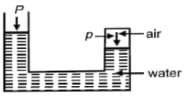
The pressure of confined air is $p$. If the atmospheric pressure is $P$, then
When length is increased on applying force, then strain is called:
Let $\vec A\, = \,(\hat i\, + \,\hat j)\,$  and $\vec B\, = \,(2\hat i\, - \,\hat j)\,.$  The magnitude of a coplanar vector $\vec C$ such that  $\vec A\cdot \vec C\, = \,\vec B\cdot \vec C\, = \vec A\cdot \vec B$ is given by