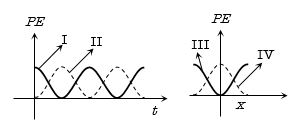
MCQ
The phase of a particle executing simple harmonic motion is $\frac{\pi }{2}$ when it has
  • A
    Maximum velocity
  • B
    Maximum acceleration
  • C
    Maximum displacement
  • Both (b) and (c)

Answer

Correct option: D.
Both (b) and (c)
d
(d) For $S.H.M.$ displacement $y = a\sin \omega \,t$ and acceleration $A = \, - {\omega ^2}y\sin \omega \,t$ these are maximum at $\omega \,t = \frac{\pi }{2}.$

Need a full question paper?

Generate a complete, print-ready paper with questions like this in minutes — across 16+ boards, with answer keys.

Start Generating Free

Similar questions

A person moves 30m North, then 20m East then $30\sqrt{2}$ South-West. His displacement from the original position is:
A triatomic, diatomic and monatomic gas is supplied same amount of heat at constant pressure, then
The maximum velocity of a body undergoing $S.H.M$. is $0.2\,m/s$ and its acceleration at $0.1\,m$ from the mean position is $0.4\,m/s^2$. The amplitude of the $S.H.M.$ is .... $m$
The graphs in figure show that a quantity $y$ varies with displacement $d$ in a system undergoing simple harmonic motion. Which graphs best represents the relationship obtained when $y$ is The time
The potential energy function for a particle executing linear SHM is given by $\text{v(x)}=\frac{1}{2}\text{kx}^2$ where k is the force constant of the oscillator. For k = 0.5N/ m, the graph of V(x) versus x is shown in the figure. A particle of total energy E turns back when it reaches $\text{x}=\pm\text{x}_\text{m}.$ If V and K indicate the P.E. and K.E., respectively of the particle at x = +xm, then which of the following is correct?

  1. V = 0, K = E
  2. V = E, K = 0
  3. V < E, K = 0
  4. V = 0, K < E
If three uniform spheres, each having mass M and radius r, are kept in such a way that each touches the other two, the magnitude of the gravitational force on any sphere due to the other two is:
In a head-on elastic collision of two bodies of equal masses:
$A$ flexible chain of length $2m$ and mass $1kg$ initially held in vertical position such that its lower end just touches a horizontal surface, is released from rest at time $t = 0$. Assuming that any part of chain which strikes the plane immediately comes to rest and that the portion of chain lying on horizontal surface does not from any heap, the height of its centre of mass above surface at any instant $t = 1/\sqrt 5$ befor it completely comes to rest) is ................ $\mathrm{m}$
We have two spheres, one of which is hollow and the other solid. They have identical masses and moment of inertia about their respective diameters. The ratio of their radius is given by
For a particle executing $S.H.M.$ the displacement $x$ is given by $x = A\cos \omega t$. Identify the graph which represents the variation of potential energy $(P.E.)$ as a function of time $t$ and displacement $x$