Question

The phenomenon of interference is shown by

(a) Longitudinal mechanical waves only

(b) Transverse mechanical waves only

(c) Electromagnetic waves only

(d) All the above types of waves

Answer

(d) All the above types of waves

Need a full question paper?

Generate a complete, print-ready paper with questions like this in minutes — across 16+ boards, with answer keys.

Start Generating Free

Similar questions

A current of 1 mA is flowing through a copper wire.  How many electrons will pass a given point in one second [e = 1.6 × 10⁻¹⁹ Coulomb]

(a) 6.25 ×  

(b) 6.25 ×  

(c) 6.25 ×

(d) 6.25 ×  

Which of the following is true

(a) Diamagnetism is temperature dependent

(b) Paramagnetism is temperature  dependent

(c) Paramagnetism is temperature independent

(d) None of these

The current density (number of free electrons per m3) in metallic conductor is of the order of:
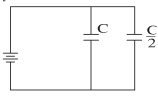
A capacitor of capacitance C and the other of capacitance $C / 2$ are connected to a battery of V volt as shown in the figure. The work done in charging both the capacitors fully is :
Image
Who discovered the magnetic effect of electric current?
 A rod of length l rotates with a small but uniform angular velocity $\omega$ about its perpendicular bisector. A uniform magnetic field B exists parallel to the axis of rotation. The potential difference between the centre of the rod and an end is:

  1. $\text{zero}$

  2. $\frac{1}{8}\omega\text{Bl}^2$

  3. $\frac{1}{2}\omega\text{Bl}^2$

  4. $\text{B}\omega\text{l}^2$ 

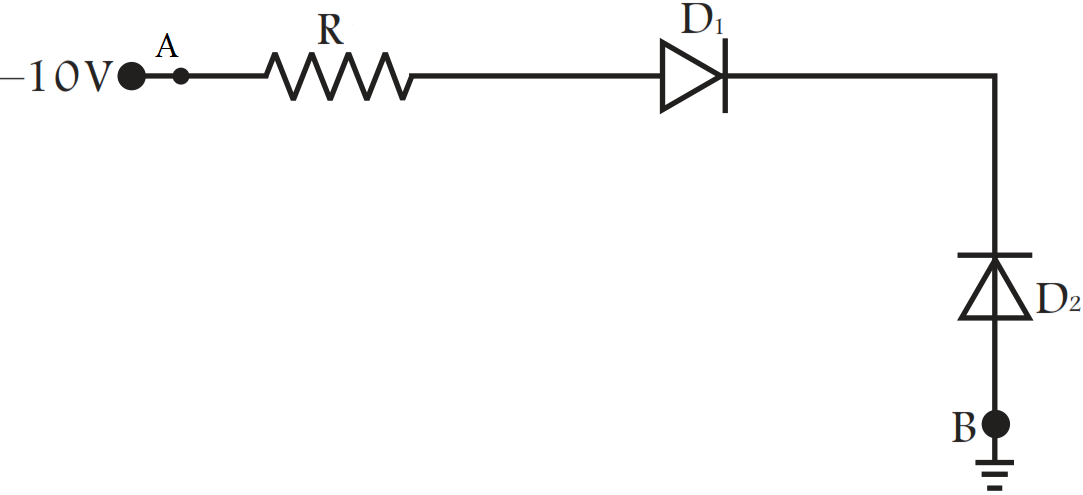
In Fig., assuming the diodes to be ideal:

A metallic shell has a point charge ‘q’ kept inside its cavity. Which one of the following diagrams correctly represents the electric lines of forces

(a)

(b)

(c)

(d)

Two resistances R and 2R are connected in parallel in an electric circuit. The thermal energy developed in R and 2R are in the ratio:
  1. 1 : 2
  2. 2 : 1
  3. 1 : 4
  4. 4 : 1

In general, metallic ropes are suspended on the carriers which take inflammable material. The reason is

(a) There speed is controlled

(b) To keep the centre of gravity of the carrier nearer to the earth

(c) To keep the body of the carrier in contact with the earth

(d) Nothing should be placed under the carrier