MCQ
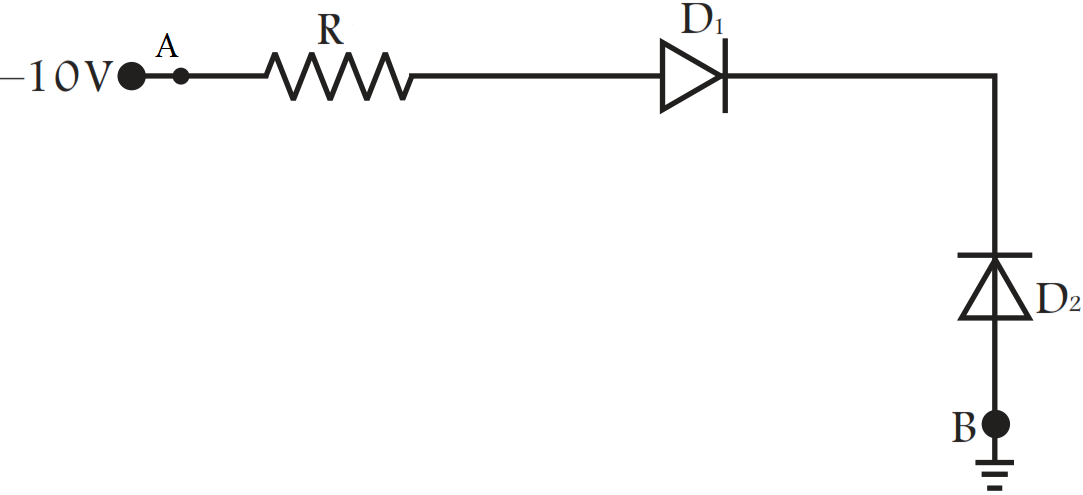
In Fig., assuming the diodes to be ideal:
  • A
    D1 is forward biased and D2 is reverse biased and hence current flows from A to B.
  • B
    D2 is forward biased and D1 is reverse biased and hence no current flows from B to A and vice versa.
  • C
    D1 and D2 are both forward biased and hence current flows from A to B.
  • D
    D1 and D2 are both reverse biased and hence no current flows from A to B and vice versa.
Answer

  1. D2 is forward biased and D1 is reverse biased and hence no current flows from B to A and vice versa.

Solution:

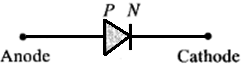
A symbol of the diode is represented like this: In this problem first we have to check the polarity of the diodes. -10 is the lower voltage in the circuit. Now p-side of p-n juction D1 is connected to lower voltage and n-side of D1 to higher voltage. Thus D1 is reverse biased. Now, let us analyse 2nd diode of the given circuit. The p-side of p-n junction D1 is at higher potential and n-side of D2 is at lower potential. Therefore D2 is forward biased.

Hence, current flows through the jucntion from B to A.

Need a full question paper?

Generate a complete, print-ready paper with questions like this in minutes — across 16+ boards, with answer keys.

Start Generating Free

Similar questions

Work done to bring a unit positive charge from infinity to a point in an electric field is known as _______?

In a compound microscope magnification will be large, if the focal length of the eye piece is

(a) Large                                            

(b) Smaller 

(c) Equal to that of objective

(d) Less than that of objective

A straight wire carrying a current  runs along the axis of a circular current . Then the force of interaction between the two current carrying conductors is

(a)     

(b) Zero

(c)  

(d)  

In Young’s double slit experiment, a minimum is obtained when the phase difference of super imposing waves is

(a) Zero  

(b) (2n – 1)π

(c) nπ

(d)  (n + 1) π

If the distance between parallel plates of a capacitor is halved and dielectric constant is doubled then the capacitance

(a) Decreases two times

(b) Increases two times

(c) Increases four times

(d) Remain the same

When photon of energy 4.25 eV strike the surface of a metal A, the ejected photoelectrons have maximum kinetic energy TA eV and de-Brolie wavelength . The maximum kinetic energy of photoelectrons liberated from another metal B by photon of energy 4.70 eV is   If the de-Broglie wavelength of these photoelectrons is  , then

(a) The work function of A is 2.25 eV

(b) The work function of B is 4.20 eV

(c)  

(d)  

When a body is charged by induction, then the body.
Magnitude of pursuit velocity does not depend on :

Newton postulated his corpuscular theory on the basis of

(a) Newton’s rings

(b) Colours of thin films

(c) Rectilinear propagation of light

(d) Dispersion of white light

What fraction of a radioactive material will get disintegrated in a period of two half-lives

(a) Whole

(b) Half

(c) One-fourth

(d) Three-fourth
