MCQ
The phenomenon utilised in an optical fibre is
  • A
    Refraction
  • B
    Interference
  • C
    Polarization
  • Total internal reflection

Answer

Correct option: D.
Total internal reflection
d
(d)

Total internal reflection is a powerful process since it can be used to confine light. One of the most common applications of total internal reflection is in fibre optics. An optical fibre is a thin, transparent fibre, usually made of glass or plastic, for transmitting light.

If light is incident on a cable end with an angle of incidence greater than the critical angle then the light will remain trapped inside the glass strand. In this way, light travels very quickly down the length of the cable over a very long distance (tens of kilometers).

Need a full question paper?

Generate a complete, print-ready paper with questions like this in minutes — across 16+ boards, with answer keys.
Start Generating Free

Similar questions

A small cylindrical soft iron piece is kept in a galvanometer so that
Four identical spheres each of mass $m$ are placed at the corners of square of side $2\,metre$. Taking the point of intersection of the diagonals as the origin, the co-ordinates of the centre of mass are
Two equal charges of magnitude $Q$ each are placed at a distance $d$ apart. Their electrostatic energy is $E$. A third charge $-Q / 2$ is brought midway between these two charges. The electrostatic energy of the system is now
A rod of ferromagnetic material with dimensions $10\, cm\times0.5\, cm\times0.2\, cm$ is placed in a magnetic field of strength $0.5\times10^4\, Am^{-1}$ as a result of which a magnetic moment of $5\, Am^2$ is produced in the rod. The value of magnetic induction will be....$T$
A certain metallic surface is illuminated with monochromatic light of wavelength, $\lambda$. The stopping potential for photo-electric current for this light is $3 V_0$  . If the same surface is illuminated with light of wavelength $2\lambda$, the stopping potential is $V_0$. The threshold wavelength for this surface for photo- electric effect is
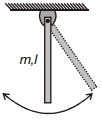
A uniform rod of mass $m$ and length $I$ is suspended about its end, Time period of small angular oscillations is ..........
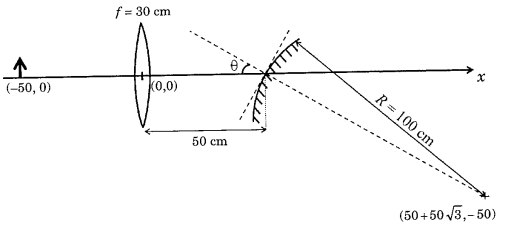
A small object is placed $50 \mathrm{~cm}$ to the left of a thin convex lens of focal length $30 \mathrm{~cm}$. A convex spherical mirror of radius of curvature $100 \mathrm{~cm}$ is placed to the right of the lens at a distance of $50 \mathrm{~cm}$. The mirror is tilted such that the axis of the mirror is at an angle $\theta=30^{\circ}$ to the axis of the lens, as shown in the figure.

If the origin of the coordinate system is taken to be at the centre of the lens, the coordinates (in $\mathrm{cm}$ ) of the point $(x, y)$ at which the image is formed are
Two particles move at right angle to each other. Their de Broglie wavelengths are ${\lambda _1}$ and ${\lambda _2}$ respectively. The particles suffere perfectly inelastic collision. The de Broglie wavelength $\lambda $ , of the final particle, is given by
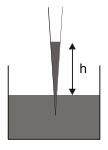
A glass capillary tube is of the shape of a truncated cone with an apex angle $\alpha$ so that its two ends have cross sections of different radii. When dipped in water vertically, water rises in it to a height $h$, where the radius of its cross section is $b$. If the surface tension of water is $S$, its density is $\rho$, and its contact angle with glass is $\theta$, the value of $h$ will be ( $g$ is the acceleration due to gravity)
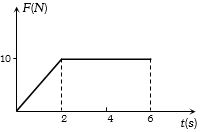
A body of mass $3\,kg$ is acted on by a force which varies as shown in the graph below. The momentum acquired is given by ........... $N-s$