MCQ
The photoelectric threshold wavelength for a metal surface is $6600\ A$. The work function for this is
  • A
    $1.87 \mathrm{~V}$
  • $1.87 \mathrm{eV}$
  • C
    $18.7 \mathrm{eV}$
  • D
    $0.18 \mathrm{eV}$

Answer

Correct option: B.
$1.87 \mathrm{eV}$
$W_0=\frac{12375}{6600}=1.87 \mathrm{eV}$.

Need a full question paper?

Generate a complete, print-ready paper with questions like this in minutes — across 16+ boards, with answer keys.
Start Generating Free

Similar questions

The temperature coefficient of resistance for a wire is $0.00125 /{ }^{\circ} \mathrm{C}$. At $300 \mathrm{~K}$ its resistance is $1 \mathrm{ohm}$. The temperature at which the resistance becomes $2 \mathrm{ohm}$ is
The angular velocity and the amplitude of a simple pendulum is $\omega$ and $a$ respectively. At a displacement $X$ from the mean position if its kinetic energy is $T$ and potential energy is $V$, then the ratio of $T$ to $V$ is
If $\gamma=2.5$ and volume is equal to $\frac{1}{8}$ times to the initial volume then pressure $P^{\prime}$ is equal to (Initial pressure $=P$ )
The phase difference between two waves represented by
$y_1=10^{-6} \sin [100 t+(x / 50)+0.5] m $
$y_2=10^{-6} \cos [100 t+(x / 50)] m $
where $x$ is expressed in metres and $t$ is expressed in seconds, is approximately
The equation of progressive wave is $y=a \sin (200 t-x)$. where $x$ is in meter and $t$ is in second. The velocity of wave is
The process in which no heat enters or leaves the system is termed as
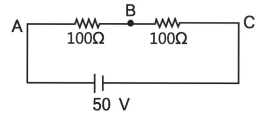
Consider the diagram shown below. A voltmeter of resistance $150\,\Omega$ is connected across $A$ and $B$. The potential drop across $B$ and $C$ measured by voltmeter is $...........\,V$
16 tunning forks are arranged in the order of increasing frequencies. Any two successive forks give $8$ beats per sec when sounded together. If the frequency of the last fork is twice the first, then the frequency of the first fork is
A body of mass $m$ moving with a constant velocity $v$ hits another body of the same mass moving with the same velocity $v$ but in the opposite direction and sticks to it. The velocity of the compound body after collision is
A gas for which $\gamma=1.5$ is suddenly compressed to $\frac{1}{4}$ th of the initial volume. Then the ratio of the final to the initial pressure is