The piston in the cylinder head of locomotive has a stroke of $6\,m$ (which is twice the amplitude). If the piston executing simple harmonic motion with an angular frequency of $200\, rad\, min^{-1}$, its maximum speed is .... $ms^{-1}$
Medium


Download our appand get started for free
Experience the future of education. Simply download our apps or reach out to us for more information. Let's shape the future of learning together!No signup needed.*
Similar Questions
- 1A simple pendulum of mass $m$ executes $S.H.M.$ with total energy $E$. If at an instant it is at one of extreme positions, then its linear momentum after a phase shift of $\frac{\pi}{3} \,rad$ will beView Solution
- 2The potential energy of a particle of mass $100 \,g$ moving along $x$-axis is given by $U=5 x(x-4)$, where $x$ is in metre. The period of oscillation is .................View Solution
- 3As a body performs $S.H.M.$, its potential energy $U.$ varies with time as indicated inView Solution
- 4The resultant of two rectangular simple harmonic motions of the same frequency and unequal amplitudes but differing in phase by $\frac{\pi }{2}$ isView Solution
- 5View SolutionWhat is constant in S.H.M.
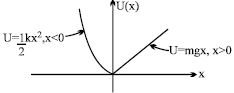
- 6A particle of mass $m$ moves in the potential energy $U$ shown above. The period of the motion when the particle has total energy $E$ isView Solution
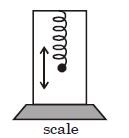
- 7View SolutionA mass hangs from a spring and oscillates vertically. The top end of the spring is attached to the top of a box, and the box is placed on a scale, as shown in the figure. The reading on the scale is largest when the mass is
- 8Time period of a simple pendulum is $T$. The time taken to complete $5 / 8$ oscillations starting from mean position is $\frac{\alpha}{\beta} T$. The value of $\alpha$ is ..... .View Solution
- 9View SolutionIn case of damped oscillation frequency of oscillation is ............
- 10The maximum velocity of a particle, executing simple harmonic motion with an amplitude $7\ mm$, is $4.4\ m/s$. The period of oscillation is .... $sec$View Solution