Question
The plate current in a diode is zero. It is possible that:

Answer

  1. The plate voltage is zero.
  2. The plate voltage is slightly negative.
  3. The plate voltage is slightly positive.
  4. The temperature of the filament is low.
Explanation:
The plate current varies directly with the plate voltage. Therefore, if the plate voltage is zero, the plate current is also zero. Due to the same reason, if the plate voltage is negative, the plate current will be zero. Now, if the plate is slightly positive, then it may be the reason that the plate voltage is not able to reduce the effect of space charge. Hence, the current may be zero. Now, as the temperature of the filament is low, it will not be able to emit electrons and the resulting plate current will be zero. Hence, all the options are possible.

Need a full question paper?

Generate a complete, print-ready paper with questions like this in minutes — across 16+ boards, with answer keys.
Start Generating Free

Similar questions

There are 8 equal resistances R. Two are connected in parallel, such four groups are connected in series, the total resistance of the system will be(a) R / 2(b) 2 R(c) 4 R(d) 8 R
       
A current $I$ is passing through a wire having two sections $P$ and $Q$ of uniform diameters $d$ and $d / 2$ respectively. If the mean drift velocity of electrons in sections $P$ and $Q$ is denoted by $v_P$ and $v_Q$ respectively, then
Electroscope is used:
As the temperature of a metallic resistor is increased, the product of its resistivity and conductivity:
In the Boolean algebra, the following one is wrong:
Following is the relation between current and charge
$I=A T^2 e^{q t / V_L}$
then value of $V_L$ will be
One conducting U tube can slide inside another as shown in figure, maintaining electric contacts between the tubes. The magnetic field B is perpendicular to the plane of the figure. If each tube moves towards the other at a constant speed v, then the emf induced in the circuit in terms of B, l and v where l is the width of each tube, will be
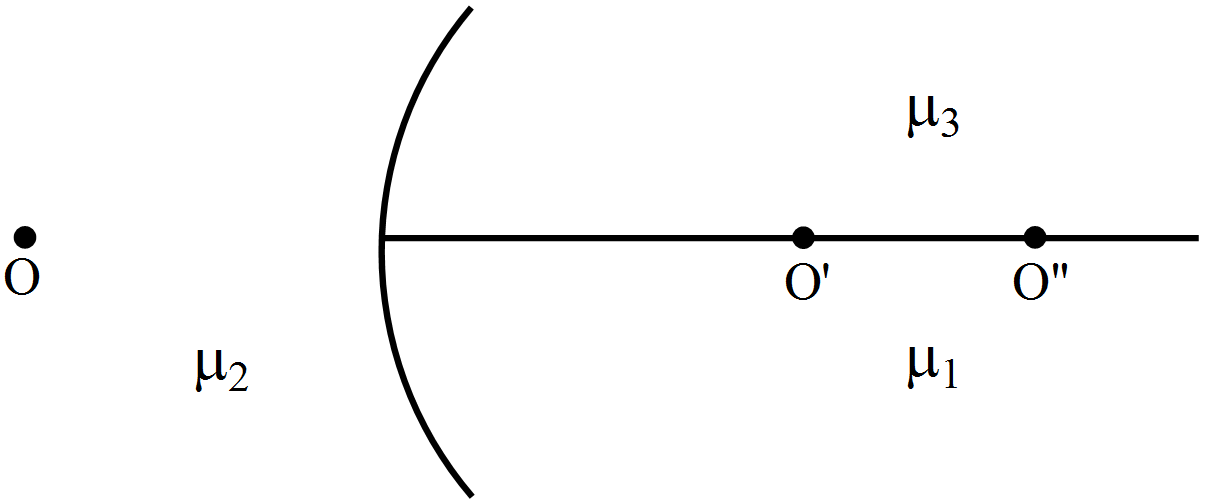
Three transparent media of refractive indices $\mu_1,\mu_2$ and $\mu_3.$ A point object $O$ is placed in the medium $\mu_2.$ If the entire medium on the right of the spherical surface has refractive index $\mu_1,$ the image forms at $O\ '$. If this entire medium has refractive index $\mu_3,$ the image forms at $O"$. In the situation shown:
A solid metallic sphere has a charge $+3Q$. Concentric with this sphere is a conducting spherical shell having charge $-Q$. The radius of the sphere is a and that of the spherical shell is $b(b > a)$. What is the electric field at a distance $R(a < R < b)$ from the centre
Joining of light nuclei of elements to form a heavy nucleus with the release of energy is called: