The plates of a parallel plate capacitor with no dielectric are connected to a voltage source. Now a dielectric of dielectric constant $K $ is inserted to fill the whole space between the plates with voltage source remaining connected to the capacitor.
Diffcult


Download our appand get started for free
Experience the future of education. Simply download our apps or reach out to us for more information. Let's shape the future of learning together!No signup needed.*
Similar Questions
- 1Two plates are at potentials $-10\, V$ and $+30\, V$. If the separation between the plates be $2\, cm$. The electric field between them is.......$V/m$View Solution
- 2In the circuit shown in the figure, $C = 6\,\mu F$. The charge stored in the capacitor of capacity $C$ is......$\mu C$View Solution
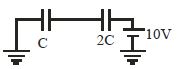
- 3Seven capacitors each of capacity $2\,\mu F$ are to be so connected to have a total capacity $\frac{{10}}{{11}}\,\mu F$. Which will be the necessary figure as shownView Solution
- 4The area of each plate of a parallel plate capacitor is $20\,cm^2$ and separation between the plates is $2\,mm$. If dielectric strength of air is $3 \times 10^6\,V/m,$ the maximum possible value of emf of the battery, which can be connected across the plates of this capacitor and the corresponding charge on the plates isView Solution
- 5If an electron enters into a space between the plates of a parallel plate capacitor at an angle $\alpha $ with the plates and leaves at an angle $\beta $ to the plates, the ratio of its kinetic energy while entering the capacitor to that while leaving will beView Solution
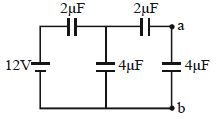
- 6Find the potential difference $V_a -V_b$ between the points $a$ and $b$ shown in each part of the figure.View Solution
- 7A parallel plate capacitor is charged and then disconnected from the source steady $E.M.F.$ The plates are then drawn apart farther. Again it is connected to the same source. Then :View Solution
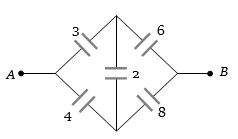
- 8Effective capacitance between $A$ and $B$ in the figure shown is (all capacitance are in $\mu F$)View Solution
- 9A capacitor of capacity $C$ has charge $Q$ and stored energy is $W$. If the charge is increased to $2Q$, the stored energy will beView Solution
- 10A regular hexagon of side $10\; cm$ has a charge $5 \;\mu\, C$ at each of its vertices. Calculate the potential at the centre of the hexagon.View Solution