A regular hexagon of side $10\; cm$ has a charge $5 \;\mu\, C$ at each of its vertices. Calculate the potential at the centre of the hexagon.
Easy
Download our app for free and get started
The given figure shows six equal amount of charges, $q$, at the vertices of a regular hexagon.
Where, Charge, $q=5\, \mu\, C=5 \times 10^{-6} \,C$
Side of the hexagon, $l= AB = BC = CD = DE = EF = FA =10 \,cm$
Distance of each vertex from centre $O , d =10\, cm$
Electric potential at point $O$
$V=\frac{1}{4 \pi \varepsilon_{0}} \cdot \frac{6 \times q}{d}$
Where,
Where, $\varepsilon_{0}=$ Permittivity of free space and $\frac{1}{4 \pi \varepsilon_{0}}=9 \times 10^{9}\, Nm ^{2} \,C ^{-2}$
$\therefore V=\frac{9 \times 10^{9} \times 6 \times 5 \times 10^{-6}}{0.1}=2.7 \times 10^{6}\, V$
Therefore, the potential at the centre of the hexagon is $2.7 \times 10^{6} \;V$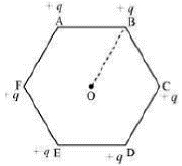

Download our appand get started for free
Experience the future of education. Simply download our apps or reach out to us for more information. Let's shape the future of learning together!No signup needed.*
Similar Questions
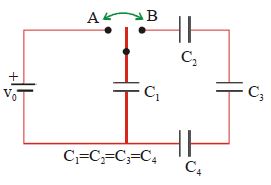
- 1The four identical capacitors in the circuit shown below are initially uncharged. The switch is then thrown first to position $A$, and then to position $B$. After this is done:View Solution
Note: $V_{1,2,3,4}$ are the potential differences across $C_{1,2,3,4}$ and $Q_{1,2,3,4}$ are the final charges stored in $C_{1,2,3,4}$ respectively.
- 2Four equal charges $Q$ are placed at the four corners of a square of each side is $'a'$. Work done in removing a charge $-Q$ from its centre to infinity isView Solution
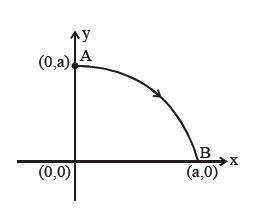
- 3Electric field at a place is $\overrightarrow {E\,} = {E_0}\hat i\,V/m$ . A particle of charge $+q_0$ moves from point $A$ to $B$ along a circular path find work done in this motion by electric fieldView Solution
- 4Eight small drops, each of radius $r$ and having same charge $q$ are combined to form a big drop. The ratio between the potentials of the bigger drop and the smaller drop isView Solution
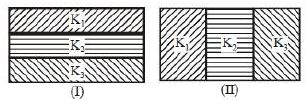
- 5Two identical parallel plate capacitors, of capacitance $C$ each, have plates of area $A$, separated by a distance $d$. The space between the plates of the two capacitors, is filled with three dielectrics, of equal thickness and dielectric constants $K_1$ , $K_2$ and $K_3$ . The first capacitor is filled as shown in fig. $I$, and the second one is filled as shown in fig. $II$. If these two modified capacitors are charged by the same potential $V$, the ratio of the energy stored in the two, would be ( $E_1$ refers to capacitor $(I)$ and $E_2$ to capacitor $(II)$)View Solution
- 6Given below are two statements: one is labelled aView Solution
Assertion $(A)$ and the other is labelled as Reason$(R)$
$Assertion$ $(A)$ : Work done by electric field on moving a positive charge on an equipotential surface is always zero.
$Reason$ $(R)$ : Electric lines of forces are always perpendicular to equipotential surfaces.
In the light of the above statements, choose the most appropriate answer from the options given below
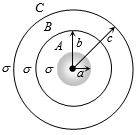
- 7Three concentric metallic shells $A, B$ and $C$ of radii $a, b$ and $c (a < b < c)$ have surface charge densities $\sigma ,\, - \sigma $ and $\sigma $ respectively. then ${V_A}$ and ${V_B}$View Solution
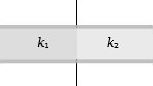
- 8A parallel plate capacitor with air as medium between the plates has a capacitance of $10\,\mu F$. The area of capacitor is divided into two equal halves and filled with two media as shown in the figure having dielectric constant ${k_1} = 2$and ${k_2} = 4$. The capacitance of the system will now be.......$\mu F$View Solution
- 9A point charge $q$ is placed in a cavity in a metal block. If a charge $Q$ is brought outside the metal, then the electric force experienced by $q$ isView Solution
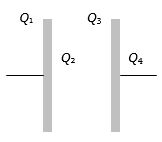
- 10In an isolated parallel plate capacitor of capacitance $C$, the four surface have charges ${Q_1}$, ${Q_2}$, ${Q_3}$ and ${Q_4}$ as shown. The potential difference between the plates isView Solution