Question
The pointer of a dead-beat galvanometer gives a steady deflection because(a) Eddy currents are produced in the conducting frame over which the coil is wound(b) Its magnet is very strong(c) Its pointer is very light(d) Its frame is made of abonite


Answer

(a) Eddy currents are produced in the conducting frame over which the coil is wound

Need a full question paper?

Generate a complete, print-ready paper with questions like this in minutes — across 16+ boards, with answer keys.

Start Generating Free

Similar questions

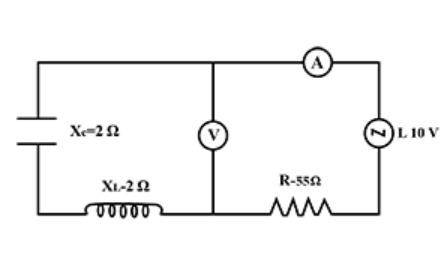
In the given figure as shown, the reading of the ammeter in ampere is.
Image
Which one of the following is not electromagnetic in nature(a) X-rays(b) Gamma rays(c) Cathode rays(d) Infrared rays
       
The magnetic field of the earth can be modelled by that of a point dipole placed at the centre of the earth. The dipole axis makes an angle of 11.3° with the axis of the earth. At Mumbai, declination is nearly zero. Then,
The magnetic induction at any point due to a long straight wire carrying a current is(a) Proportional to the distance from the wire(b) Inversely proportional to the distance from wire(c) Inversely proportional to the square of the distance from the wire(d) Does not depend on distance


The resistance of a wire is 20 ohms. It is so stretched that the length becomes three times, then the new resistance of the wire will be(a) 6.67 ohms(b) 60.0 ohms(c) 120 ohms(d) 180.0 ohms
       
If a rod has resistance $4\Omega$ and if rod is turned as half cycle then the resistance along diameter
How will two parallel beams of electron behave while moving in the same direction?
A square current loop is suspended in a uniform magnetic field which is located at its base. If force on one arm of the loop is $\vec{F}$. Then the resultant force on rest three arms is :
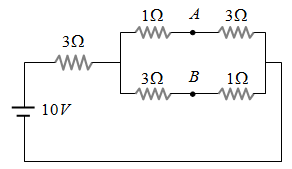
A battery of $e.m.f. 10 V$ is connected to resistance as shown in figure. The potential difference $V_A-V_B$  between the points $A$ and $B$ is
Period of revolution increases in the order of (a) Saturn, Uranus, Venus(b) Mars, Saturn, Pluto(c) Mercury, Neptune, Mars(d) Mars, Jupiter, Venus