Question
How will two parallel beams of electron behave while moving in the same direction?

Answer

  1. Attract each other
Explanation:
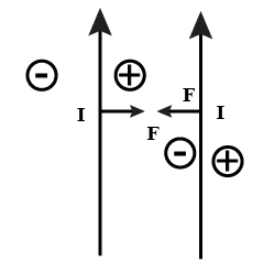
Two parallel beams of electron moving in the same direction can be think of like two current carrying wire in same direction.
The situation is shown in the figure. The direction indicated shows that wire 2 will be attracted towards wire 1. In a similar manner, one can show that wire 1 will experience a force due to the magnetic field of wire 2, and that this force will have a magnitude equal to that of F2 but opposite in direction. Thus, wire 1 will be attracted towards wire 2.

Need a full question paper?

Generate a complete, print-ready paper with questions like this in minutes — across 16+ boards, with answer keys.
Start Generating Free

Similar questions

What is the net electric field in the outer regions above the upper plate and below the lower plate in a parallel plate capacitor?
A nucleus of an element $84^{\mathrm{x}^{202}}$ emits an $\alpha-$particle first, a $\beta-$particle next and then a gamma photon. The final nucleus formed has an atomic number
In an adiabatic process on a gas with $\gamma=1.4,$ the pressure is increased by 0.5%. The volume decreases by about:
  1. 0.36%
  2. 0.5%
  3. 0.7%
  4. 1%​​
A body is suspended from a spring balance kept in a satellite. The reading of the balance is $W_{1 }$when the satellite goes in an orbit of radius $R$ and is $W_2$ when it goes in an orbit of radius $2R.$
One cannot see through fog because .......... :
In a photon-particle collision, the quantity that does not remain conserved is:
You are given a resistance wire of length 50 cm and a battery of negligible resistance. In which of the following cases is largest amount of heat generated(a) When the wire is connected to the battery directly(b) When the wire is divided into two parts and both the parts connected to the battery in parallel(c) When the wire is divided into four parts and all the four connected to the battery in parallel(d) When only half the wire is connected to the battery


A neutron exerts a force on a proton which is:
  1. Gravitational.
  2. Electromagnetic.
  3. Nuclear.
  4. Weak.
The device, which can be used to detect whether an object is charged, is:
In the circuit diagram shown in the adjoining figure, the resultant capacitance between $P$ and $Q$ is