MCQ
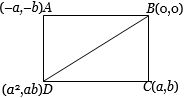
The points $( - a,\, - b),\;(0,\,0),\;(a\,,b)$ and $({a^2},ab)$ are
  • Collinear
  • B
    Vertices of a rectangle
  • C
    Vertices of a parallelogram
  • D
    None of these

Answer

Correct option: A.
Collinear
a
(a) Here area of quadrilateral is equal to area of $\Delta ABD$+area of $\Delta BCD$
$ = \left| {\begin{array}{*{20}{r}}{ - a}&{ - b}&1\\0&0&1\\{{a^2}}&{ab}&1\end{array}\,} \right| + \left| {\begin{array}{*{20}{r}}0&0&1\\a&b&1\\{{a^2}}&{ab}&1\end{array}\,} \right| = 0$

Hence the points are collinear.

Need a full question paper?

Generate a complete, print-ready paper with questions like this in minutes — across 16+ boards, with answer keys.

Start Generating Free

Similar questions

If $\sqrt {x + iy} = \pm (a + ib),$ then $\sqrt { - x - iy} $ is equal to
If ${( - 7 - 24i)^{1/2}} = x - iy,$ then ${x^2} + {y^2} = $
Consider the following two statement. 

Statement $p$ : The value of $sin\,120^o$ can be divided by taking $\theta\, = 240^o$ in the equation $2\,\sin \frac{\theta }{2} = \sqrt {1 + \sin \theta }  - \sqrt {1 - \sin \theta } $ 

Statement $q$ : The angles $A, B, C$ and $D$ of any quadrilateral $ABCD$ satisfy the equation $\cos \left( {\frac{1}{2}\left( {A + C} \right)} \right) + \cos \left( {\frac{1}{2}\left( {B + D} \right)} \right) = 0$ 

Then the truth values of $p$ and $q$ are respectively.

$\sqrt { - 8 - 6i} = $
Total number of words formed by 2 vowels and 3 consonants taken from 4 vowels and 5 consonants is equal to:
 
If $\tan \left(\frac{\pi}{9}\right), x, \tan \left(\frac{7 \pi}{18}\right)$ are in arithmetic progression and $\tan \left(\frac{\pi}{9}\right), y, \tan \left(\frac{5 \pi}{18}\right)$ are also in arithmetic progression, then $|x-2 y|$ is equal to:
If complex number $z = x + iy$ is taken such that the amplitude of fraction $\frac{{z - 1}}{{z + 1}}$ is always $\frac{\pi }{4}$, then
If ${z_1},{z_2}$ and ${z_3},{z_4}$ are two pairs of conjugate complex numbers, then $arg\left( {\frac{{{z_1}}}{{{z_4}}}} \right) + arg\left( {\frac{{{z_2}}}{{{z_3}}}} \right)$ equals
The argument of the complex number $ - 1 + i\sqrt 3 $ is ............. $^\circ$
If $z$ is a complex number, then the minimum value of $|z| + |z - 1|$ is