MCQ
The position of a particle moving along the $X-$axis at certain times is given below :Which of the following describes the motion correctly

$\begin{array}{|c|c|c|c|c|} \hline t( s ) & 0 & 1 & 2 & 3 \\ \hline x ( m ) & -2 & 0 & 6 & 16 \\ \hline \end{array} $

  • A
    Uniform, accelerated
  • B
    Uniform, decelerated
  • Non-uniform, accelerated
  • D
    There is not enough data for generalization
Answer

Correct option: C.
Non-uniform, accelerated
c
(c) Instantaneous velocity $v = \frac{{\Delta x}}{{\Delta t}}$

By using the data from the table

${v_1} = \frac{{0 - ( - 2)}}{1} = 2\,m/s$

${v_2} = \frac{{6 - 0}}{1} = 6\;m/s$

${v_3} = \frac{{16 - 6}}{1} = 10\;m/s$

So, motion is non-uniform but accelerated.

Need a full question paper?

Generate a complete, print-ready paper with questions like this in minutes — across 16+ boards, with answer keys.

Start Generating Free

Similar questions

An ideal gas heat engine operates in a Carnot cycle between $227^o C$ and $127^o C$. It absorbs $6\,kcal$ at the higher temperature. The amount of heat (in $kcal$) converted into work is equal to
A force acts on a $3 \,gm$ particle in such a way that the position of the particle as a function of time is given by $x = 3t - 4{t^2} + {t^3}$, where $x$ is in metres and $t$ is in seconds. The work done during the first $4 \,seconds$ is ..... $mJ$
A dielectric slab is inserted between the plates of an isolated capacitor. The force between the plates will:
The energy of an atom $($or ion$)$ in its ground state is $-54.4eV$. It may be:
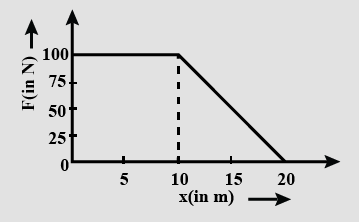
A force $F$ acting on an object varies with distance $x$ as shown in the figure. The work done by the force in moving the object from $x = 0$ and $x = 20m$ is:
The ratio of the adiabatic to isothermal elasticities of a triatomic gas is
The position of a particle as a function of time $t$, is given by $x\left( t \right) = at+ b{t^2} - c{t^3}$ where $a, b$ and $c$ are constants. When the particle attains zero acceleration, then its velocity will be
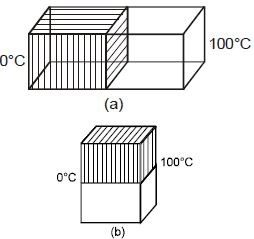
Two identical square rods of metal are welded end to end as shown in figure $(a)$. Assume that $10\, cal$ of heat flows through the rods in $2\, min$. Now the rods are welded as shown in figure, $(b)$. The time it would take for $10$ cal to flow through the rods now, is ........ $\min$
A particle moves on $x-$ axis according to the equation $x = x_0\,\,sin^2\,\omega t,$  the motion is simple harmonic
A composite rod made of three rods of equal length and cross-section as shown in the fig. The thermal conductivities of the materials of the rods are $K/2, 5K$ and $K$ respectively. The end $A$ and end $B$ are at constant temperatures. All heat entering the face Agoes out of the end $B$ there being no loss of heat from the sides of the bar. The effective thermal conductivity of the bar is