Question
The position of an object is given by $x=2 t^2+3 t$. Find out that its motion is uniform and non-uniform.

Answer

As given, $x=2 t^2+3 t$ By differentiating x w.r.t. t, we get Velocity, $\text{v}=\frac{\text{dx}}{\text{dt}}=\frac{\text{d}}{\text{dt}}(2\text{t}^2+3\text{t})$ $\text{v}=(4\text{t}+3)$ As velocity is time dependent, it means that motion is non-uniform.

Need a full question paper?

Generate a complete, print-ready paper with questions like this in minutes — across 16+ boards, with answer keys.
Start Generating Free

Similar questions

Find the number of molecules of an ideal gas in a volume of $1.000cm^3a$ at STP.
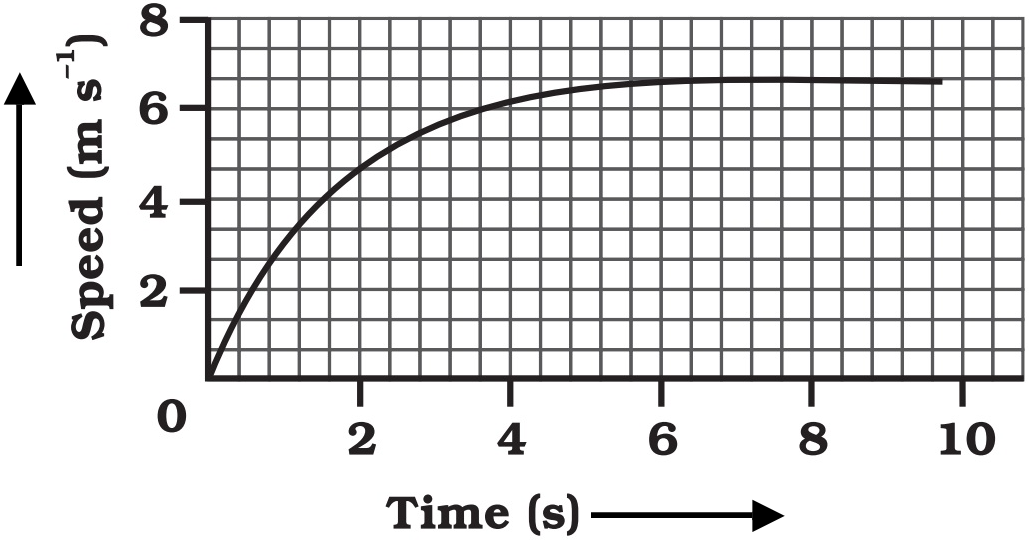
The speed$-$time graph for a car is shown in figure below.
  1. Find how far the car travels in the first $4s?$ Shade the area on the graph that represents the distance travelled by the car during the period.
  2. Which part of the graph represent uniform motion of the car?
Explain why Water with detergent disolved in it should have small angles of contact.
A boy is standing on a platform which is free to rotate about its axis. The boy holds an open umbrella in his hand. The axis of the umbrella coincides with that of the platform. The moment of inertia of ''the platform plus the boy system'' is $3.0 \times 10^{-3}kg-m^2$ and that of the umbrella is $2.0 \times 10^3kg-m^2$. The boy starts spinning the umbrella about the axis at an angular speed of $2.0rev/s$ with respect to himself. Find the angular velocity imparted to the platform.
Two springs $A$ and $B$ with constants $\mathrm{k}_{\mathrm{A}}$ and $\mathrm{k}_{\mathrm{B}}\left(\mathrm{k}_{\mathrm{A}}>\mathrm{k}_{\mathrm{B}}\right)$ are given. In which of the springs more work is to be done if,
  1. They are stretched by the same amount.
  2. They are stretched by same force.
Explain the terms: Young's modulus of elasticity and elastic fatigue.
A solid sphere of radius R made of a material of bulk modulus B is surrounded by a liquid in a cylindrical container. A mass less piston of area A floats on the surface of the liquid. When a mass M is placed on the piston to compress the liquid, find fractional change in the radius of the sphere?
Find the height to which water at $4^{\circ} \mathrm{C}$ will rise in a capillary tube of $10^{-3} \mathrm{~m}$ diameter. Take $\mathrm{g}=9.8 \mathrm{~ms}^{-2}$. Angle of contact, $\theta=0$ and $\mathrm{T}=0.072 \mathrm{Nm}^{-1}$.
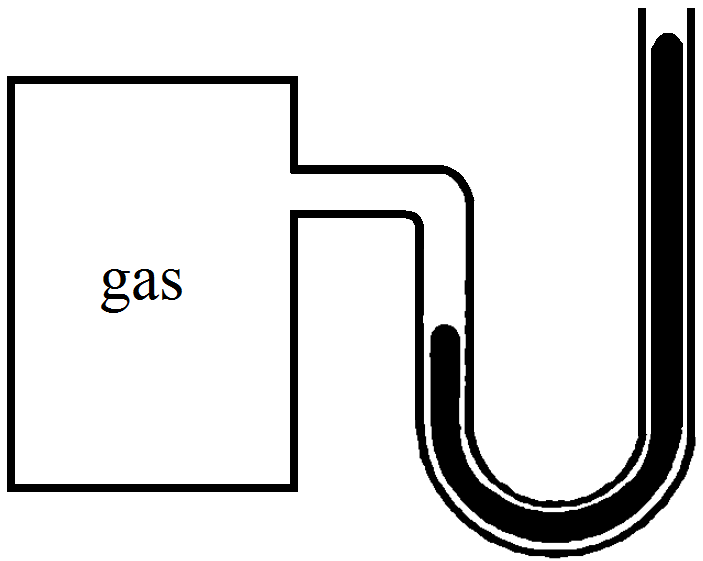
The heights of mercury surfaces in the two arms of the manometer shown in figure are $2\ cm$ and $8\ cm$. Atmospheric pressure $= 1. 01 x 10^5N/rn^2$. Find.
  1. Thepressure of the gas in the cylinder and.
  2. The pressure of mercury at the bottom of the $U$ tube.
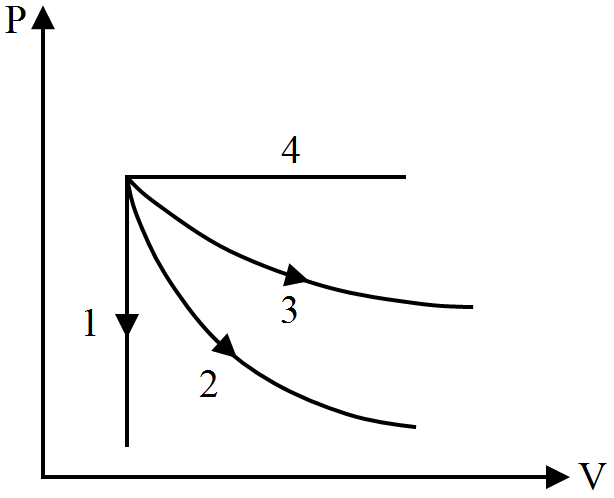
Identify and name the thermodynamic processes marked as $1, 2, 3$ and $4$ as shown in figure.