Question

The position of certain elements in the Modem Periodic Table are shown below.
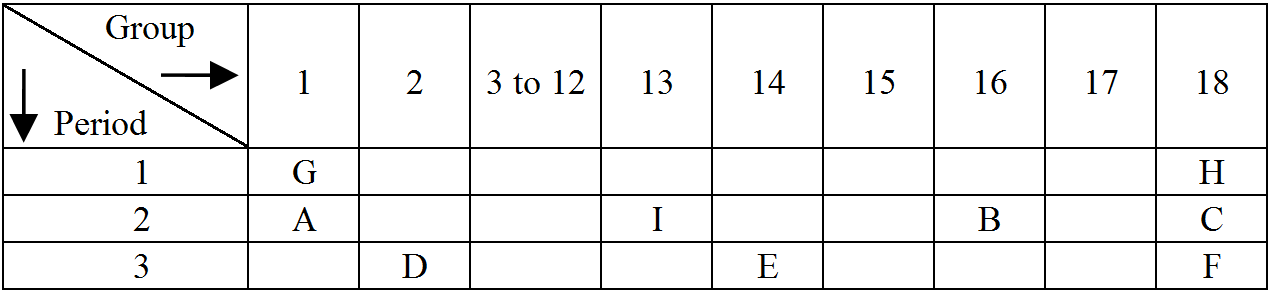
Using the above table answer the followmg questions giving reasons in each case:
  1. Which element will form only covalent compounds?
  2. Which element is a non-metal with valency 2?
  3. Which element is a metal with valency 2?
  4. Out of H, C and F which has largest atomic size?
  5. To which family does H, C and F belong?

Answer

  1. Element E is Silicon. It will form a covalent bond only. The outermost orbit of silicon has four electrons and it needs four more electrons to become stable.
  2. Non-metal with valency 2 is B, which is Oxygen. Oxygen has a high electronegativity, due to which it has a higher tendency to attract electrons rather than donating them.
  3. Element D is a metal with valency 2. Element D is magnesium, due to its low electronegativity it has a very high tendency to donate electrons.
  4. Element F has the largest atomic size. According to the electronic configuration of element F which is argon, it occupies 3 energy shells compared to elements H and C which occupies one and two energy shells and due to this its atomic radius is the largest.
  5. Elements H, C, and F belong to Group number eighteen, which means according to their outer electronic configuration their octet is complete and thus these elements are stable. They have a very low tendency to react with other elements. Group eighteen elements belong to the noble gas family.

Need a full question paper?

Generate a complete, print-ready paper with questions like this in minutes — across 16+ boards, with answer keys.

Start Generating Free

Similar questions

An organic compound A (molecular formula $C _2 H _4 O _2$ ) reacts with Na metal to form a compound B and evolves a gas which burns with a pop sound. Compound A on treatment with an alcohol C in the presence of a little of concentrated sulphuric acid forms a sweet-smelling compound D (molecular formula $C _3 H _6 O _2$ ). Compound D on treatment with NaOH solution gives back B and C. Identify A, B, C and D.
Explain the phenomenon of dispersion of white light through a glass prism, using suitable ray diagram.
A man with blood group A marries a woman with blood group O and their daughter has blood group O. Is this information enough to tell you which of the traits-blood group A or O - is dominant? Why or why not?
How is the equal genetic contribution of male and female parents ensured in the progeny?
  1. State Fleming’s left hand rule.
  2. Write the principle of working of an electric motor.
  3. Explain the function of the following parts of an electric motor.
  1. Armature.
  2. Brushes.
  3. Split ring.
Name various plant hormones. Also give their physiological effects on plant growth and development.
How do genes control the traits? Explain in detail.
i. Name the disorder which a person is likely to suffer from due to the following:
I. Over-secretion of growth hormone
II. Deficiency of oestrogen in females
III. Less secretion of thyroxineAlso name the gland that secretes each of the hormones mentioned above.
ii. How is the timing and amount of hormone released regulated? Explain with the help of an example.
There are four organisms A, B, C and D. The organism A eats only the flesh of other animals as food. The organism B can eat grains, fruits and vegetables as well as meat and fish. The organism C can make the food itself from simple inorganic substances present in the environment by utilising sunlight energy. On the other hand, organism D eats only plants and their products as food.
  1. Which organism is
  1. Omnivore,
  2. Herbivore,
  3. Carnivore?
  1. Which organism is an autotroph?
  2. Which organism is/ are heterotroph (s)?
  3. Which organism can be a producer?
  4. Which organism is/ are consumer (s)?
Give one example each of organisms which could be like A, B, C and D.
How many pairs of chromosomes are present in human beings? Out of these how many are sex chromosomes? How many types of sex chromosomes are found in human beings?
"The sex of a newborn child is a matter of chance and none of the parents may be considered responsible for it". Draw a flow chart showing determination of sex of a newborn to justify this statement.