Questions

[5 marks Questions]

🎯

Test yourself on this topic

42 questions · timed · auto-graded

Question 15 Marks
Explain the trends in the Modern Periodic Table of various properties like valency, atomic size, metallic and non-mettalic properties of the atoms of elements.
Answer
  1. Valency. Elements belonging to same group have same number of valence electrons and thus same valency.
Valency in a particular period from left to right first increases as positive valency and ‘ then decreases as negative valency. Example, In elements of 2nd period: Li ha $\text{1}^{+}$ valency, then $\text{Be}^ {2+}, \text{Be}^{3+}, \text{C}^{4+}$ covalency, $\text{N}^{3-}$ valency, then $\text{O}^{2-}\text{and F}^{(-)}$ valency.
  1. The atomic size or atomic radius increases as we move down in a group and it decreases as we move from left to right in a period. Atomic size increases down a group due to increase in the number of shells. Atomic size decreases along a period due to increase in the nuclear charge which tends to pull the electrons closer to the nucleus and reduces the size of the atom.
  2. Metallic and non-metallic properties. In the modern periodic table metals are on the left side and non-metals are on the right side. A zigzag line of metalloids separates metals from non-metals. Metallic character decreases from left to right in a period and increases while going down in a group. Non-metallic character increases from left to right in a period due to increase in the electro-negativity and this character decreases from top to bottom in a group due to decrease in the electro-negativity of atoms while going down in a group.
View full question & answer
Question 25 Marks
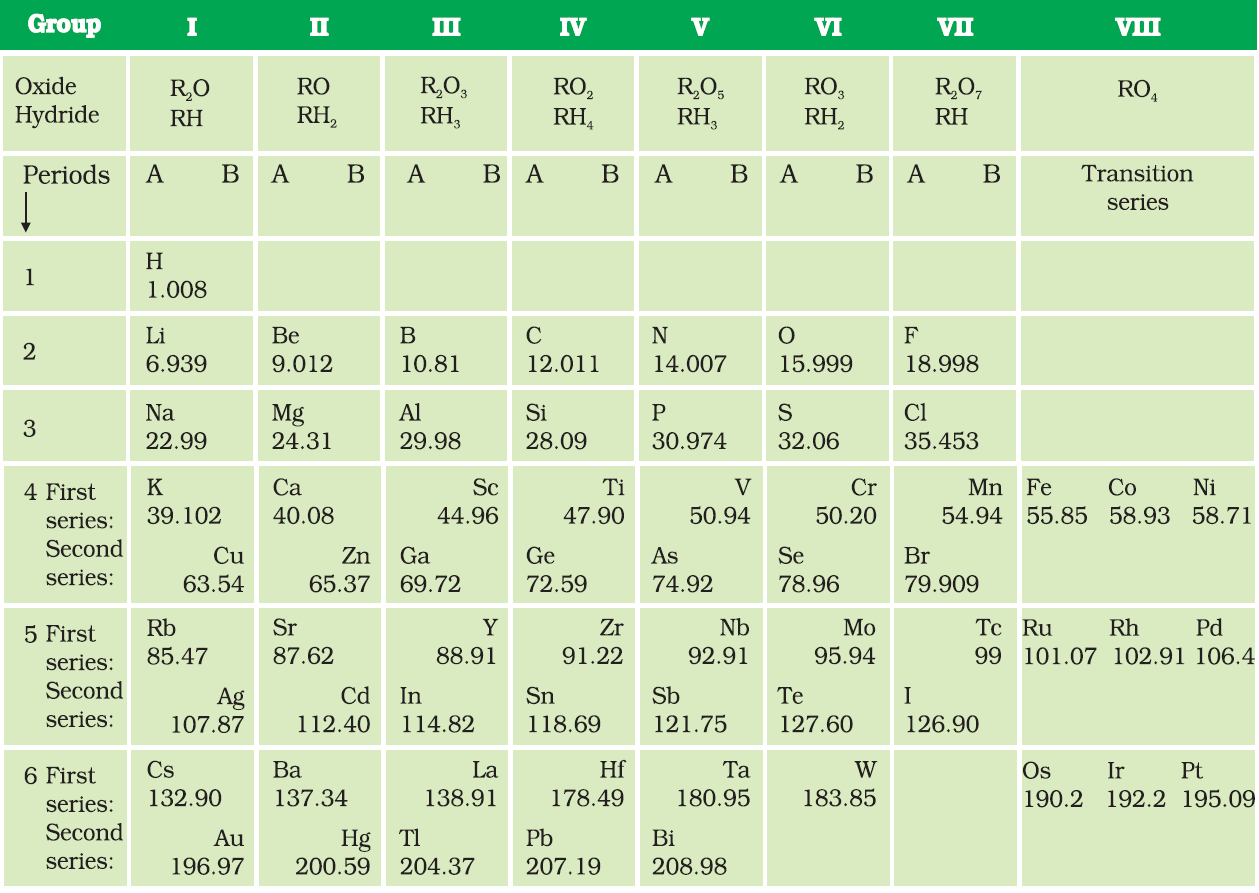
On the basis of Mendeleev’s Periodic Table given below, answer the questions that follow the table:
  1. Name the element which is in:
  1. i. $1^{\text {st }}$ group and $3^{\text {rd }}$ period.
    ii. $VII ^{\text {th }}$ group and 2nd period.
  1. Suggest the formula for the following:
  1. Oxide of nitrogen.
  2. Hydride of oxygen.
  1. In group VIII of the Periodic Table, why does cobalt with atomic mass 58.93 appear before nickel having atomic mass 58.71?
  2. Besides gallium, which two other elements have since been discovered for which Mendeleev had left gaps in his Periodic Table?
  3. Using atomic masses of Li, Na and K, find the average atomic mass of Li and K and compare it with the atomic mass of Na. State the conclusion drawn from this activity.
Answer
  1.  
  1. Sodium.
  2. Fluorine.
  1.  
  1. i. $N _2 O _5$
    ii. $H _2 O / OH _2$
  1. Modern periodic table arranges the elements according to increasing atomic numbers. So, the atomic number of cobalt (27) comes first whereas the atomic number of nickel (28) comes later.
  2. Scandium (Sc) and Germanium. (Ge)
  3. The atomic mass of Li is 6 & atomic mass of K is 40. We know that, $\text{Na}=\frac{\text{Li}+\text{K}}{2}$. Therefore, K = 6 + 40 ÷ 2K = 23 we know that atomic mass of Na is 23. Thus, average of atomic masses of Li & K gives atomic mass if Na Regards.
View full question & answer
Question 35 Marks
  1. Why do we classify elements?
  2. What were the two criteria used by Mendeleev in creating his Periodic Table?
  3. Why did Mendeleev leave some gaps in his Periodic Table?
  4. In Mendeleev’s Periodic Table, why was there no mention of Noble gases like Helium, Neon and Argon?
  5. Would you place the two isotopes of chlorine Cl- 35 and Cl- 37 in different slots because of their different atomic masses or in the same slot because their chemical properties are the same? Justify your answer.
Answer
  1. To make the understanding of properties of elements and compounds simpler/To make order out of chaos.
  2. The criteria used by Mendeleev in creating his periodic table:
  1. He arranged the elements on the basis of their increasing atomic masses.
  2. He put elements of similar properties in a group.
  1. To make sure that elements with similar properties lie in the same group, Mendeleev left some gaps in the periodic table. These gaps were left for subsequent inclusion of the elements not known at that time. The elements were discovered later.
  2. There was no mention of noble gases like helium, neon and argon as they were not known at that time and were discovered much later.
  3. Same slot because their chemical properties are same.
View full question & answer
Question 45 Marks
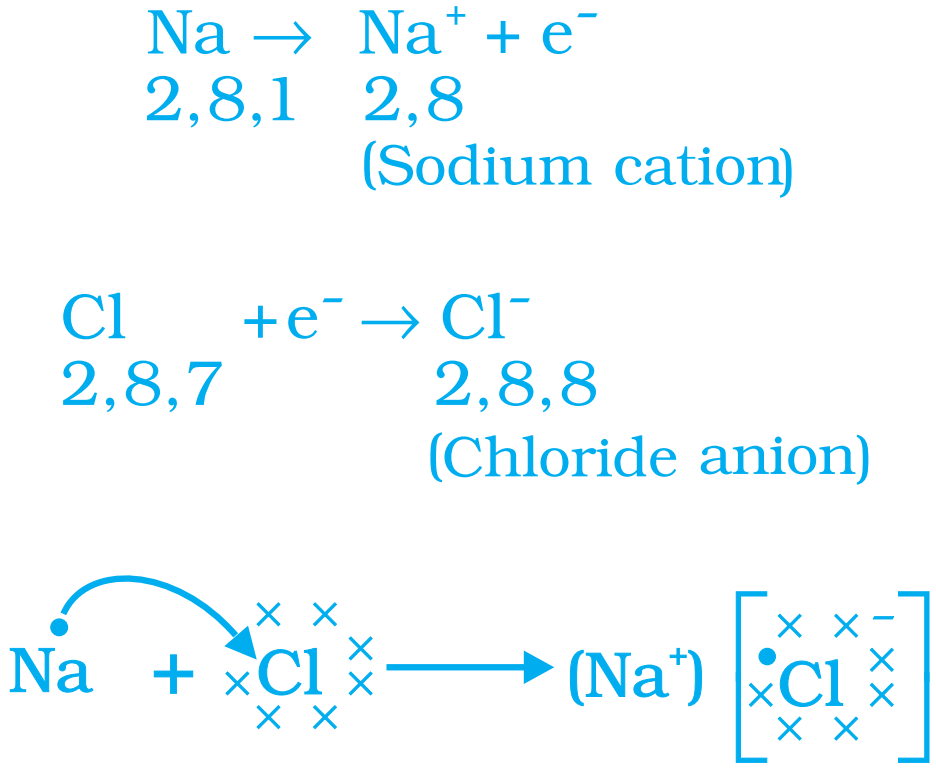
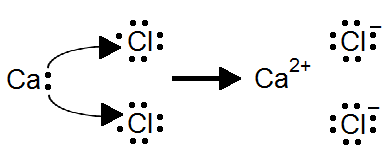
Write the names and symbols of two most reactive metals belonging to group I of the periodic table. Explain by drawing electronic structure how either one of the two metals reacts with a halogen. With which name is the bond formed between these elements known and what is the class of the compound so formed known? State any four physical properties of such compounds.
Answer

The two reactive metals are spdium (Na) and potassium (K). Sodium reacts with chlorine.

Electrovalent bond and Ionic compounds.
Physical properties of such compounds are:
  1. They are good conductors of electricity.
  2. They are generally soluble in water and insoluble in organic solvents.
  3. They are solids, hard, brittle.
  4. Crystalline solid at room temperature.
  5. Ionic compounds have high melting and boiling points.
View full question & answer
Question 55 Marks
  1. Why did Mendeleev have gaps in his periodic table?
  2. State any three limitations of Mendeleev’s classification.
  3. How does electronic configurations of atoms change in a period with increase in atomic number?
Answer
  1. To make sure that elements with similar properties lie in the same group, Mendeleev left some gaps in the periodic table. These gaps were left for subsequent inclusion of the elements not known at that time. The elements were discovered later
  2. Limitations of Mendeleev’s classification are:
  1. Position of hydrogen was not justified.
  2. Increasing order of atomic mass could not be maintained.
  3. Isotopes have similar chemical properties but different atomic masses, they cannot be given separate Places.
  1. The atomic number of elements increases by a factor of 1 as we move from left to right across a period. We know that elements in a period involve the filling of same valence shell. So in a period, the electronic configuration mainly involves changes in the valence shell. For example, consider carbon, nitrogen and oxygen. All these elements belong to the $2^{\text {nd }}$ period. The atomic number of carbon is 6 of nitrogen is 7 while that of oxygen is 8 . So, the electronic configuration of carbon is 2,4 ; of nitrogen is 2,5 while that of oxygen is 2,6
View full question & answer
Question 65 Marks
  1. Which two criteria did Mendeleev use to classify the elements in his periodic table?
  2. State Mendeleev’s periodic law.
  3. Why could no fixed position be given to hydrogen in Mendeleev’s periodic table?
  4. How and why does the atomic size vary as you go:
  1. From left to right along a period?
  2. Down a group?
Answer
  1. The criteria used by Mendeleev in creating his periodic table:
  1. He arranged the elements on the basis of their increasing atomic masses.
  2. He put elements of similar properties in a group.
  1. He gave a law known as periodic law. The law states that the physical and chemical properties of elements are periodic function of their atomic weights.
  2. Hydrogen resembles like both the alkali metals and the halogens. Hence, it was placed in I A group VI B group and could not be given a fixed position in Mendeleev’s Periodic Table.
  1.  
  1. When we move from left to right in periodic table no. of shells remain same but the no. of electron increases due to which the size of an atom decreases.
  2. When we move down a group the no. of shells goes on increases and hence the size of atom also increases.
View full question & answer
Question 75 Marks
  1. The modern periodic table has been evolved through the early attempts of Dobereiner, Newland and Mendeleev. List one advantage and one limitation of all the three attempts.
  2. Name the scientist who first of all showed that atomic number of an element is a more fundamental property than its atomic mass.
  3. State Modern periodic law.
Answer
  1.  
  1. Dobereiner’s triad:
Advantage: The three elements of the triad possess similar properties.
Limitation: Some elements which are not similar were grouped into a triad.
  1. Newland’s octave:
Advantage: The properties of every eighth element are similar to the properties of the first element.
Limitation: To fit the existing element arrangement, Newlands placed two elements in the same position which differed in their properties.
  1. Mendeleev’s Periodic Table:
Advantage: The properties of elements in a particular period show regular gradation from left to right.
Limitation: The position of isotopes could not be explained. Isotopes are atoms of the same element having similar chemical properties but different atomic masses. If elements are arranged according to atomic masses, then isotopes should be placed in different groups of the periodic table.
  1. Mendeleev showed that atomic number of an element is a more fundamental property than its atomic mass.
  2. Modern periodic law: Properties of elements are a periodic function of their atomic number.
View full question & answer
Question 85 Marks

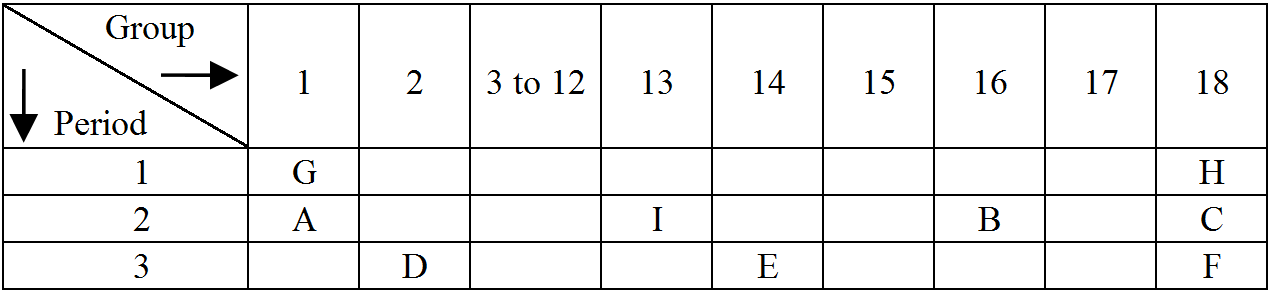
The position of certain elements in the Modem Periodic Table are shown below.

Using the above table answer the followmg questions giving reasons in each case:
  1. Which element will form only covalent compounds?
  2. Which element is a non-metal with valency 2?
  3. Which element is a metal with valency 2?
  4. Out of H, C and F which has largest atomic size?
  5. To which family does H, C and F belong?
Answer
  1. Element E is Silicon. It will form a covalent bond only. The outermost orbit of silicon has four electrons and it needs four more electrons to become stable.
  2. Non-metal with valency 2 is B, which is Oxygen. Oxygen has a high electronegativity, due to which it has a higher tendency to attract electrons rather than donating them.
  3. Element D is a metal with valency 2. Element D is magnesium, due to its low electronegativity it has a very high tendency to donate electrons.
  4. Element F has the largest atomic size. According to the electronic configuration of element F which is argon, it occupies 3 energy shells compared to elements H and C which occupies one and two energy shells and due to this its atomic radius is the largest.
  5. Elements H, C, and F belong to Group number eighteen, which means according to their outer electronic configuration their octet is complete and thus these elements are stable. They have a very low tendency to react with other elements. Group eighteen elements belong to the noble gas family.
View full question & answer
Question 95 Marks
Define atomic size. Give its unit of measurement. In the modem periodic table what trend is observed in the atomic radius in a group and a period and why is it so?
Answer
Atomic size is the distance between the center of an atom i.e. from the nucleus to the outermost shell (valence shell) of that atom.
Atomic size is measured in Angstroms $(\dot{\text{A}})$ where 1 Angstrom $=10^{-10}$ meters.
In the modern periodic table, the atomic size of elements increases down the group and the atomic size decrease along the period from left to right.
Down the group, as the number of energy shells of the atoms keeps on increasing from top to bottom so, the atomic radius also increases.
During the period, the atomic number of elements increases which leads to an increase in the number of protons inside the nucleus and thus, the effective nuclear charge increases. So, the atomic radius decreases over the period.
View full question & answer
Question 105 Marks
What are the merits of the modern periodic table of elements?
Answer
Merits of modern periodic table:
  1. The modern periodic table is based on the atomic numbers of elements which is the most fundamental property of elements.
  2. It helps us to understand why elements in a group show similar properties but elements in different groups show different properties.
  3. It explains the reasons for the periodicity in properties of elements.
  4. It tells us why the properties of elements are repeated after 2, 8, 18 and 32 elements.
View full question & answer
Question 115 Marks
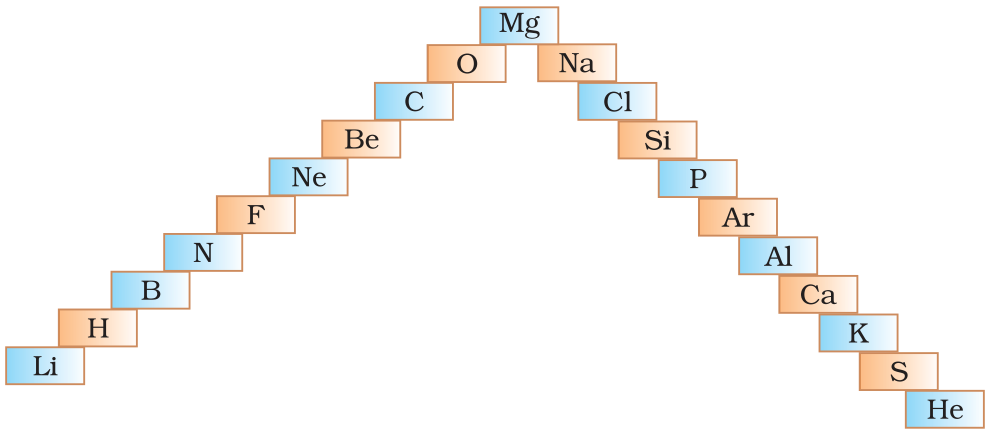
  1. In this ladder (Figure) symbols of elements are jumbled up. Rearrange these symbols of elements in the increasing order of their atomic number in the Periodic Table.
  1. Arrange them in the order of their group also.
Answer
  1. The symbols of elements in increasing order of their atomic numbers are:
H, He, Li, Be, B, C, N, O, F, Ne, Na, Mg, Al, Si, P, S, Cl, Ar, K, Ca.
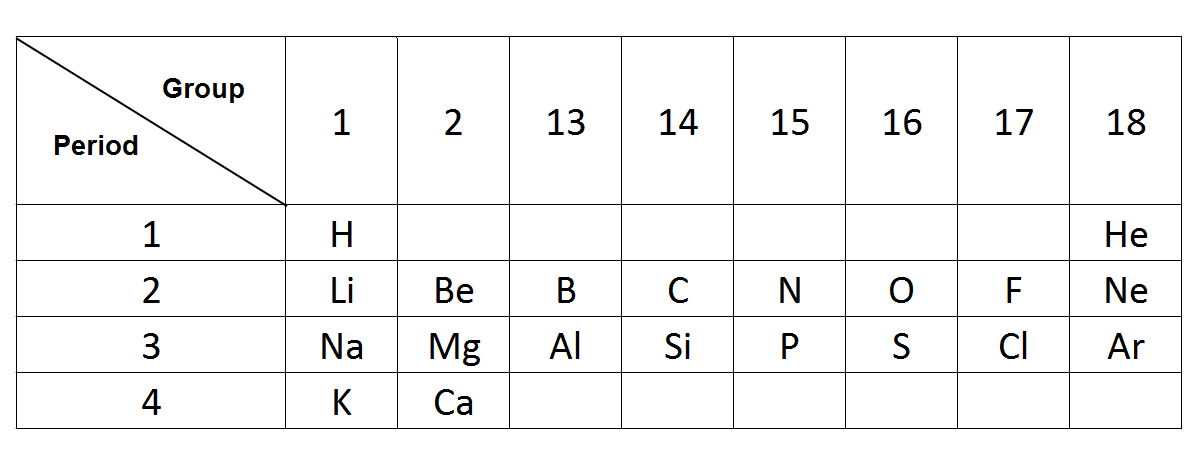
  1. The symbols of elements in increasing order of their group numbers are as follows.
View full question & answer
Question 125 Marks
Can the following groups of elements be classified as Dobereiner's triads?
  1. Na, Si, Cl.
  2. Be, Mg, Ca.
Give reason for your answer.

(Atomic masses: Be 9; Na 23; Mg 24; Si 28; Cl 35. 5; Ca 40)
Answer
  1. No. This is because the elements Na, Si and Cl do not have similar properties even though the atomic mass of middle element Si is almost equal to the average atomic mass of first element Na and third element Cl.
  2. Yes. This is because the elements Be, Mg and Ca have similar properties and the atomic mass of middle element Mg is almost equal to the average atomic mass of first element Be and third element Ca.
View full question & answer
Question 135 Marks
Mendeleev predicted the existence of certain elements not known at that time and named two of them as Eka-silicon and Eka-aluminium.
  1. Name the elements which have taken the place of these elements.
  2. Mention the group and the period of these elements in the Modern Periodic Table.
  3. Classify these elements as metals, non-metals or metalloids.
  4. How many valence electrons are present in each one of them?
Answer
  1. Eka-silicon was later identified as Germanium (Ge) and Eka- aluminium was taken as Gallium (Ga).
  2.  
  • Germanium (Ge)- Group 14, period 4.
  • Gallium (Ga)- Group 13, period 4.
  1. Gallium(Ga) is a metal while Germanium (Ge) is a metalloid.
  2. Gallium is placed in $13^{\text {th }}$ group so there must be $13-10=3$ valence electrons. Similarly germanium is placed in group 14 so there must be $14-10=4$ valence electrons.
View full question & answer
Question 145 Marks
An element X (atomic number 17) reacts with an element Y (atomic number 20) to form a divalent halide.
  1. Where in the periodic table are elements X and Y placed?
  2. Classify X and Y as metal (s), non-metal (s) or metalloid (s)
  3. What will be the nature of oxide of element Y? Identify the nature of bonding in the compound formed.
  4. Draw the electron dot structure of the divalent halide.
Answer
  1. X is in Group 17, period 3 and Y is in group 2, period 4.
  2. X is a non-metal, While Y is a metal.
  3. Oxide of element Y would be basic. This compound is formed by ionic bond.
  4.  
View full question & answer
Question 155 Marks
The following diagram shows a part of the periodic table in which the elements are arranged according to their atomic numbers.
(The letters given here are not the chemical symbols of the elements):
a
3
b
4
 
c
5
d
6
e
7
f
8
g
9
h
10
i
11
j
12
 
k
13
l
14
m
15
n
16
o
17
p
18
  1. Which element has a bigger atom, a or f?
  2. Which element has a higher valency, k or o?
  3. Which element is more metallic, i or k?
  4. Which element is more non-metallic, d or g?
  5. Select a letter which represents a metal of valency 2.
  6. Select a letter which represents a non-metal of valency 2.
Answer
  1. A (size decreases from left to right in a period).
  2. K (valency of k = 3; valency of o = 1).
  3. I (metallic character decreases from left to right in a period).
  4. G (non - metallic character increases from left to right in a period).
  5. B (or j).
  6. F (or n).
View full question & answer
Question 165 Marks
An element X of group 15 exists as diatomic molecule and combines with hydrogen at 773K in presence of the catalyst to form a compound, ammonia which has a characteristic pungent smell.
  1. Identify the element X. How many valence electrons does it have?
  2. Draw the electron dot structure of the diatomic molecule of X. What type of bond is formed in it?
  3. Draw the electron dot structure for ammonia and what type of bond is formed in it?
Answer
  1. The available information suggests that the element X is nitrogen (N) and exists in diatomic form as N, Electronic configuration of N(Z = 7); 2, 5. It has five valence electrons.
  2.  
  1.  
View full question & answer
Question 175 Marks
Mendeleev predicted the existence of certain elements not known at that time and named two of them as eka - aluminium, and eka - silicon.
  1. Name the element which has taken the place of (i) eka - aluminium, and (ii) eka - silicon.
  2. Mention the period/ periods of these elements in the modern periodic table.
  3. Write the group/ groups of these elements in the modern periodic table.
  4. Classify these elements as metals, non - metals or metalloids.
  5. How many valence electrons are present in the atoms of each of these elements?​​​​​​
Answer
  1.  
  1. Gallium.
  2. Germanium.
  1. $4^{\text {th }}$ period.
    Gallium: $13^{\text {th }}$ group; Germanium: $14^{\text {th }}$ group..
  2. Gallium: Metal; Germanium: Metalloid.
  3. Gallium: 3; Germanium: 4.
View full question & answer
Question 185 Marks
Arrange the following elements in the increasing order of their metallic character Mg, Ca, K, Ge, Ga.
Answer
The arrangement of given elements in the Modern Periodic table is listed below.
Group/ Period
1
2
13
14
3
 
Mg
 
 
4
K
Ca
Ga
Ge
We know that metallic character decreases from left to right in the periodic table. In the given elements, excluding Mg, remaining elements are placed in same period so the metallic character will decrease from K to Ge and order of metallic character would be;
Ge < Ga < Ca < KNow, as we move down in a group, metallic nature of elements increases. So, Ca is more metallic than Mg. Similarly, Mg will be less metallic than K because in period, metallic nature decreases from left to right. Hence the increasing order of metallic character would be;
Ge < Ga < Mg < Ca < K
View full question & answer
Question 195 Marks
A part of the early classification of elements has been given below:$\text{H}\ \ \ \ \ \ \ \text{Li} \ \ \ \ \ \ \ \text{Be} \ \ \ \ \ \ \ \ \ \text{B}\ \ \ \ \ \ \ \text{C}\ \ \ \ \ \ \ \text{N}\ \ \ \ \ \ \ \text{O}\\\text{F}\ \ \ \ \ \ \ \text{Na}\ \ \ \ \ \ \text{Mg}\ \ \ \ \ \ \ \text{Al}\ \ \ \ \ \ \text{Si}\ \ \ \ \ \ \ \text{P}\ \ \ \ \ \ \ \ \text{S}$
  1. Which law of classification of element is illustrated by the above arrangement of elements?
  2. Name the scientist who proposed such a classification of elements.
  3. Why is such a classification of elements compared with a characteristics of musical scale?
  4. State one limitation of this classification of elements.
Answer
  1. Newlands' law of octaves is illustrated by the above arrangement of elements.
  2. John Newlands is the scientist who proposed this classification of elements.
  3. This classification is compared with a characteristic of the musical scale because the repetition of the properties of elements is just like the repetition of the eighth note in an octave of music.
  1. Limitation:
Newlands' law of octaves could only be applied up to the element calcium.
View full question & answer
Question 205 Marks
How do the following change on going from left to right in a period of the periodic table?
  1. Chemical reactivity of elements.
  2. Nature of oxides of elements Give examples in support of your answer.
Answer
  1. On moving from left to right in a period, the chemical reactivity of elements first decreases and then increases.
Example: In the 3rd period of elements, sodium is a very reactive element, magnesium is less reactive whereas aluminium is still less reactive. Silicon is the least reactive in the third period. Now, phosphorus is quite reactive, sulphur is still more reactive whereas chlorine is very reactive.
  1. On moving from left to right in a period, the basic nature of oxides decreases and the acidic nature of oxides increases.
Example: In the 3rd period of the periodic table, sodium oxide is highly basic in nature and magnesium oxide is comparatively less basic. The aluminium and silicon oxides are amphoteric in nature. Phosphorus oxides are acidic, sulphur oxides are more acidic whereas chlorine oxides are highly acidic in nature.
View full question & answer
Question 215 Marks
What are the advantages of the periodic table?
Answer
Advantages of the periodic table:
  1. It has made the study of chemistry systematic and easy.
  2. It is easier to remember the properties of an element if its position in the periodic table is known.
  3. The type of compounds formed by an element can be predicted by knowing its position in the periodic table.
  4. It is used as a teaching aid in chemistry in schools and colleges.
View full question & answer
Question 225 Marks
A non - metal X which is the largest constituent of air combines with hydrogen when heated in the presence of iron as catalyst to form a gas Y. When gas Y is treated with sulphuric acid, it forms a compound Z which is used as a chemical fertiliser.
  1. What are X, Y and Z?
  2. To which group of periodic table does X belong?
  3. Name the period of periodic table in which X is placed.
  4. Which element is placed just before X in the period?
  5. Which element is placed just after X in the period?
Answer
a. X is nitrogen gas, $N ; Y$ is ammonia gas, NH and Z is ammonium sulphate, $\left( NH _4\right)_2 SO _4$.
b. $15^{\text {th }}$ group.
c. $2^{\text {nd }}$ period.
d. Carbon, C.
e. Oxygen, O.
View full question & answer
Question 235 Marks
An element X belongs to group 2 and another element Y belongs to group 15 of the periodic table:
  1. What is the number of valence electrons in X?
  2. What is the valency of X?
  3. What is the number of valence electrons in Y?
  4. What is the valency of Y? Explain how you have arrived at your answers.
Answer
  1. 2.
For groups 1 and 2, the number of valence electrons is equal to the group number.
  1. 2.
Valency is determined by the number of valence electrons present in the atom of the element.
  1. 5.
For groups 13 to 18, the number of valence electrons is equal to (group no. – 10).
  1. 3.
The number of electrons lost or gained by one atom of an element to achieve the nearest inert gas configuration, gives us the valency.
View full question & answer
Question 245 Marks
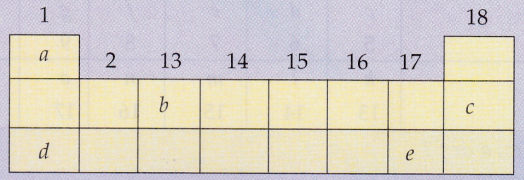
The following diagram shows a part of the periodic table containing first three periods in which five elements have been represented by the letters a, b, c, d and e (which are not their chemical symbols):
  1. Select the letter which represents an alkali metal.
  2. Select the letter which represents a noble gas.
  3. Select the letter which represents a halogen.
  4. What type of bond is formed between a and e?
  5. What type of bond is formed between d and e?
Answer
  1. d.
  2. c.
  3. e.
  4. Covalent bond.
  5. Ionic bond.
View full question & answer
Question 255 Marks
  1. Electropositive nature of the element(s) increases down the group and decreases across the period.
  2. Electronegativity of the element decreases down the group and increases across the period.
  3. Atomic size increases down the group and decreases across a period (left to right).
  4. Metallic character increases down the group and decreases across a period.
On the basis of the above trends of the Periodic Table, answer the following about the elements with atomic numbers 3 to 9.
  1. Name the most electropositive element among them.
  2. Name the most electronegative element.
  3. Name the element with smallest atomic size.
  4. Name the element which is a metalloid.
  5. Name the element which shows maximum valency.
Answer
  1. Element with 3 as atomic number, i.e. Lithium.
  2. Element with 9 as atomic number, i.e. Fluorine.
  3. Fluorine.
  4. Carbon, valency 4.
View full question & answer
Question 265 Marks
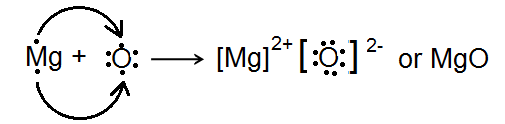
An element is placed in 2nd Group and 3rd Period of the Periodic Table, burns in presence of oxygen to form a basic oxide.
  1. Identify the element.
  2. Write the electronic configuration.
  3. Write the balanced equation when it burns in the presence of air.
  4. Write a balanced equation when this oxide is dissolved in water.
  5. Draw the electron dot structure for the formation of this oxide.
Answer
  1. The element is magnesium (Mg).
  2. The electronic configuration is 2, 8, 2.
  3. Magnesium burns in oxygen (air) to form magnesium oxide which is of basic nature.
$2 Mg(s)+O_2(g) \rightarrow 2 MgO(s)$
d. Magnesium hydroxide is formed.
$MgO(s)+H_2 O(aq) \rightarrow Mg(OH)_2(s)$
View full question & answer
Question 275 Marks
Atoms of eight elements A, B, C, D, E, F, G and H have the same number of electron shells but different number of electrons in their outermost shells. It was found that elements A and G combine to form an ionic compound. This ionic compound is added in a small amount to almost all vegetables and dishes during cooking. Oxides of elements A and B are basic in nature while those of elements E and F are acidic. The oxide of element D is, however, almost neutral. Based on the above information, answer the following questions:
  1. To which group or period of the periodic table do these elements belong?
  2. What would be the nature of compound formed by a combination of elements B and F?
  3. Which two of these elements could definitely be metals?
  4. Which one of the eight elements is most likely to be found in gaseous state at room temperature?
  5. If the number of electrons in the outermost shell of elements C and G be 3 and 7 respectively, write the formula of the compound formed by the combination of C and G.
View full question & answer
Question 285 Marks
Which group of elements could be placed in Mendele′ ev's Periodic Table without disturbing the original order? Give reason.
Answer
Inert gases could be placed in Mendeleev’s Periodic Table without disturbing the original order.
Noble gases; like Helium, Neon and Argon had been mentioned by various scientists even before Mendeleev. But these gases could be grouped together as noble gases much later than Mendeleev’s discovery. Mendeleev used 63 elements till his periodic table because these were the only known elements till his time. However, he was bold enough to leave gaps in his periodic table. He had predicted that that more elements would be discovered in times to come.
Mendeleev’s Periodic Table was the first comprehensive attempt to classify elements on the basis of their chemical properties. This is the main reason that new elements could be easily placed in Mendeleev’s Periodic Table without disturbing the original order.
View full question & answer
Question 295 Marks
The position of certain elements in the Periodic Table are shown below.
Group
Period
1
2
3 to 12
13
14
15
16
17
18
1
G


H
2
A
 
 
I
 
 
B
 
C
3
 
D
 
 
E


F
Using the above table answer the following questions:
  1. Which element will form only covalent compounds?
  2. Which element is a non-metal with valency 2?
  3. Which element is a metal with valency 2?
  4. Out of H, C, F, which has largest atomic size?
  5. Give name of family to which H, C and F belong?
Answer
  1. Element E will from only covalent compounds,
  2. Element D will have valency 2 which is metal,
  3. Element B is a non metal having valency 3, and Element D has larger radius because as move right of the periodic table, atomic radius decreases.
  4. Electrons come closer to the nucleus due to opposite charges of electron and nucleus.
  5. The elements C and F are called as Halogens.
View full question & answer
Question 305 Marks
Properties of the elements are given below. Where would you locate the following elements in the periodic table?
  1. A soft metal stored under kerosene.
  2. An element with variable (more than one) valency stored under water.
  3. An element which is tetravalent and forms the basis of organic chemistry.
  4. An element which is an inert gas with atomic number 2.
  5. An element whose thin oxide layer is used to make other elements corrosion resistant by the process of “anodising”.
Answer
  1. Sodium (Group 1 and Period 3) or Potassium (Group 1 and Period 4).
  2. Phosphorus (Group 15 and Period 3). It shows variable valencies 3 and 5 and is stored under water.
  3. Carbon (Group 14 and Period 2).
  4. Helium (Group 18 and Period 1).
  5. Aluminium (Group 13 and Period 3).
View full question & answer
Question 315 Marks
An element belongs to $4^{\text {th }}$ period and group 17 of the periodic table. Find out:
  1. The number of valence electrons.
  2. Is it a metal or non-metal.
  3. The name of the element.
  4. Formula of its compound with hydrogen.
  5. Electron dot structure of this element with calcium.
Answer
  1. 7.
  2. It is a non-metal.
  3. Bromine.
  4. HBr(Hydrogen bromide).
  5.  
View full question & answer
Question 325 Marks
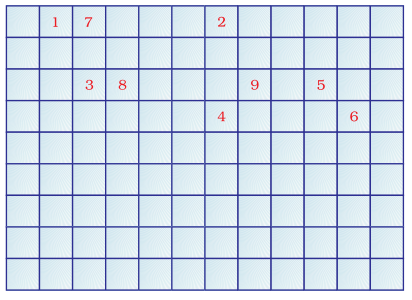
Complete the following cross word puzzle (Figure).
Across:
  1. An element with atomic number 12.
  1. Metal used in making cans and member of Group 14.
  2. A lustrous non-metal which has 7 electrons in its outermost shell.
​​​​​​​Down:
  1. Highly reactive and soft metal which imparts yellow colour when subjected to flame and is kept in kerosene.
  1. The first element of second Period.
  2. An element which is used in making fluorescent bulbs and is second member of Group 18 in the Modern Periodic Table.
  3. A radioactive element which is the last member of halogen family.
  4. Metal which is an important constituent of steel and forms rust when exposed to moist air.
  5. The first metalloid in Modern Periodic Table whose fibres are used in making bullet-proof vests.
Answer
Across:
  1. Magnesium.
  1. Tin.
  2. Iodine.
Down:
  1. Sodium.
  1. Lithium.
  2. Neon.
  3. Astatine.
  4. Iron.
  5. Boron.
View full question & answer
Question 335 Marks
Give an account of the process adopted by Mendele′ ev for the classification of elements. How did he arrive at “Periodic Law”?
Answer
Mendeleev purposed the relation between atomic masses of elements and their properties. He examined that physical and chemical properties of elements are periodic function of their atomic masses. He arranged all known 63 elements according to their atomic masses.
He examined the compounds formed by elements hydrogen and oxygen. He used these elements because they readily form different compounds with other elements like hydride and oxides.
The chemical properties of hydrides and oxides were used to determine the chemical properties of different elements and that again used for their classification. He recorded properties of all 63 elements and paired the elements which exhibit same chemical properties. Later he arranged elements on the basis of their similarities in chemical properties and found that most of the elements were arranged in order of their increasing atomic masses.
In this arrangement, he also observed the periodic recurrence of elements with similar physical and chemical properties. He formulated the periodic law which states that the properties of elements are the periodic function of their atomic masses.
View full question & answer
Question 345 Marks
An element has electronic configuration 2, 8, 7.
  1. To which group and period of the long form of Periodic Table does it belong?
  2. What is atomic number of this element?
  3. Is it metallic or non-metallic and why?
  4. Identify the element.
  5. Name an element chemically similar to this element.
Answer
  1. Period no: 3, Group no: 17.
  2. The atomic no of this element (Chlorine) is 17.
  3. It is a non-metal because it accepts electron to complete its octet.
  4. The element is Chlorine(Cl) and it has valency = 1.
  5. F(9).
View full question & answer
Question 355 Marks
How could the Modern Periodic Table remove various anomalies of Mendeléev’s Periodic Table?
Answer
Various anomalies of Mendeleev's Periodic Table removed as follows in the Modern Periodic Table:
  1. Elements are arranged in the increasing order of their atomic number in Modern Periodic Table, thus there was no need for keeping more than one element in one slot.
  2. In Modern Periodic Table there was no problem of the place of isotopes, as isotopes have same atomic mass with different atomic numbers.
  3. Elements having same valence electron are kept in same group.
  4. Elements having same number of shells were put under the same period.
  5. Position of hydrogen became clarified in as it is kept in the group with the elements of same valence electrons.
View full question & answer
Question 365 Marks
Atomic number of a few elements are given below:
10, 20, 7, 14
  1. Identify the elements.
  2. Identify the Group number of these elements in the Periodic Table.
  3. Identify the Periods of these elements in the Periodic Table.
  4. What would be the electronic configuration for each of these elements?
  5. Determine the valency of these elements.
Answer
Atomic Number
10
20
7
14
Element
Neon
Calcium
Nitrogen
Silicon
Group Number
(8 + 10) = 18
2
(5 + 10) = 15
(4 + 10) = 14
Period Number
$2^{\text {nd }}$ $4^{\text {th }}$ $2^{\text {nd }}$ $3^{\text {rd }}$
Electronic Configuration
2, 8
2, 8, 8, 2
2, 5
2, 8, 4
Valency
Zero
2
(8 - 5) = 3
4
View full question & answer
Question 375 Marks
Compare and contrast the arrangement of elements in Mendeléev’s Periodic Table and the Modern Periodic Table.
Answer
Mendeleev's periodic table
Modern periodic table
Elements are arranged in the increasing order of their atomic masses.
Elements are arranged in the increasing order of their atomic numbers.
There are 8 Groups.
There are 18 Groups.
Each groups are subdivided into sub group 'a' and 'b'
Groups are not subdivided into sub-groups.
Groups for Noble gas was not present as noble gases were not discovered by that time.
A seprate group is meant for noble gases.
There was no place for isotopes.
This problem has been rectified as slots are determined according to
atomic number.
View full question & answer
Question 385 Marks
An element X which is a yellow solid at room temperature shows catenation and allotropy. X forms two oxides which are also formed during the thermal decomposition of ferrous sulphate crystals and are the major air pollutants.
  1. Identify the element X.
  2. Write the electronic configuration of X.
  3. Write the balanced chemical equation for the thermal decomposition of ferrous sulphate crystals?
  4. What would be the nature (acidic/ basic) of oxides formed?
  5. Locate the position of the element in the Modern Periodic Table.
Answer
  1. The available information suggests that the element X is sulphur.
  2. Electronic configuration of S(Z = 16) 2, 8, 6.
  3. $2\text{FeSO}_4.7\text{H}_2\text{O(s)}\xrightarrow{\ \ \ \text{heat}\ \ \ }\text{Fe}_2\text{O}_3(\text{s})+\text{SO}_2(\text{g})+\text{SO}_3(\text{g})+7\text{H}_2\text{O(g)}$
  4. $Fe _2 O _3$ (basic oxide), $SO _2$ (acidic oxide), $SO _3$ (acidic oxide).
  5. Sulphur is a member of group 16 and period 3.
View full question & answer
Question 395 Marks
Find the valency of first twenty elements.
Answer
The valency of first 20 elements is as follows:
  1. Hydrogen(H) = 1
  2. Helium(He) = 0
  3. Lithium(Li) = 1
  4. Beryllium(Be) = 2
  5. Boron(B) = 3
  6. Carbon(C) = 4
  7. Nitrogen(N) = 3
  8. Oxygen(O) = 2
  9. Fluorine(F) = 1
  10. Neon(Ne) = 0
  11. Sodium(Na) = 1
  12. Magnesium(Mg) = 2
  13. Aluminium(Al) = 3
  14. Silicon(Si) = 4
  15. Phosphorus(P) = 3, 5
  16. Sulphur(S) = 2
  17. Chlorine(Cl) = 1
  18. Argon(Ar) = 0
  19. Potassium(K) = 1
  20. Calcium(Ca) = 2
The valencies of first 20 elements you remember their atomic numbers and find the valencies of them by using their electronic configuration.
View full question & answer
Question 405 Marks
“The atomic number of Lithium is 3.” On the basis of this information answer the question that follows:
  1. Write the electronic configuration of Li.
  2. To which group Li belong?
  3. Find valency of Li.
  4. Identify type of ion it will form.
  5. Write down the formula of the compound formed by it.
Answer
a. 2,1
b. 1st
c. $1^{+}$
d. Cation
e. $Li _2 O$
View full question & answer
Question 415 Marks
The position of five elements in the periodic table are shown below:
  Group 1 Group 2 Group 16 Group 16
Period 1   A   B
Period 3 C   D E
What are the number of valence electrons in B?
Identify the element(s) which
  1. Will have the smallest atomic radius?
  2. Will be the most metallic?
  3. Will form basic oxide?
  4. Will show valency three?
  5. Will show greatest tendency to gain electron?
Answer
Since, we know that elements in $16^{\text {th }}$ group have 6 electrons in their outer most shell i.e. the valence electrons are 6 . Therefore, we can say that B has 6 valence electrons.
(Note: For this case ignore the period.)
i. We know that element in lower period have smaller radius as compared other as they have less no. of shells. Also, going along period the size of atom decreases as the effective nuclear charge on outer electrons increases. So, B will have smallest size as it lies in $1^{\text {st }}$ period and $16^{\text {th }}$ group.
ii. We know that, the metallic character increases going down the group and decreases going right along the period. Thus $C$ will be most metallic of all.
iii. Since C and A lie in $1^{\text {st }}$ and $2^{\text {nd }}$ group so these can readily lose electron and thus can form basic oxides.
iv. We know that elements of $15^{\text {th }}$ group need only three electrons to complete their octet configuration and thus show valency 3 . So, D will show valency 3 .
v. We know that tendency to gain electron or electron gain enthalpy increases going right along period and decreases going down the group. Thus, B will show highest tendency to gain electrons
View full question & answer
Question 425 Marks
a. Non-metal A which is the largest constituent of air combines with hydrogen on heating in the presence of Fe (as catalyst) and forms a gas.
b. When this gas B is treated with $H _2 SO _4$, compound C is formed which is broadly used as chemical fertiliser.
i. Identify A, B and C.
ii. Locate the position of $A$ in the modern periodic table.
iii. Which elements are present before and after the element $A$ ?
iv. Write the electronic configuration of element A .
Answer
Non-metal A is Nitrogen which is the largest constituent of air combines with hydrogen on heating in the presence of Fe (as catalyst) and forms a gas B i.e., Ammonia $NH_3$

When this ammonia gas is treated with $H _2 SO _4$, compound C i.e. ammonium sulphate is formed which is broadly used as chemical fertiliser.
$2 NH_3+H_2 SO \rightarrow\left(NH_4\right)_2 SO_4$
i. Compound A is Nitrogen.
Compound B is Ammonia.
Compound C is Ammonium nitrate.
ii. Position of Nitrogen in periodic table = Group is 15, VA and period is 2.
iii. Carbon is present before the Nitrogen and Oxygen is present after the oxygen.
iv. The atomic number of nitrogen is 7 . So, iv) electronic configuration of nitrogen: $1 s^2 2 s^2 2 p^3$
View full question & answer
[5 marks Questions] - Science STD 10 Questions - Vidyadip