MCQ
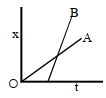
The position-time graphs for two students $A$ and $B$ returning from the school to their homes are shown in figure

$(A)$ $A$ lives closer to the school

$(B)$ $B$ lives closer to the school

$(C)$ $A$ takes lesser time to reach home

$(D)$ $A$ travels faster than $B$

$(E)$ $B$ travels faster than $A$

Choose the correct answer from the options given below :
  • $(A)$ and $(E)$ only
  • B
    $(B)$ and $(E)$ only
  • C
    $(A), (C)$ and $(E)$ only
  • D
    $(A), (C)$ and $(D)$ only

Answer

Correct option: A.
$(A)$ and $(E)$ only
a
As slope of $B$ > Slope of $A$

$\therefore V_B > V_A$

Also, $t _{ B } < t _{ A }$

Need a full question paper?

Generate a complete, print-ready paper with questions like this in minutes — across 16+ boards, with answer keys.

Start Generating Free

Similar questions

A sound source of frequency $170 Hz$ is placed near a wall. A man walking from a source towards the wall finds that there is a periodic rise and fall of sound intensity. If the speed of sound in air is $340\, m/s$ the distance (in metres) separating the two adjacent positions of minimum intensity is
A train moves towards a stationary observer with speed $34 m/s$. The train sounds a whistle and its frequency registered by the observer is ${f_1}$. If the train’s speed is reduced to $17\, m/s$, the frequency registered is ${f_2}$. If the speed of sound is 340 m/s then the ratio ${f_1}/{f_2}$ is
In a steady state, the temperature at the end $A$ and $B$ of $20\,cm$ long rod $AB$ are $100\,^oC$ and $0\,^oC$ respectively. The temperature of a point $9\,cm$ from $A$ is....... $^oC$
A compass needle is placed in the gap of a parallel plate capacitor. The capacitor is connected to a battery through a resistance. The compass needle:
  1. Does not deflect.
  2. Deflects for a very short time and then comes back to the original position.
  3. Deflects and remains deflected as long as the battery is connected.
  4. Deflects and gradually comes to the original position in a time that is large compared to the time constant.
A rocket is launched normal to the surface of earth, away from the Sun, along the line joining the Sun and the Earth. The Sun is $3 \times 10^5$ times heavier than the Earth and is at a distance $2.5 \times 10^4$ times larger than the radius of the Earth. The escape velocity from Earth's gravitational field is $\mathrm{ve}_{\mathrm{e}}=11.2 \mathrm{~km} \mathrm{~s} \mathrm{~s}^{-1}$. The minimum initial $\left(\mathrm{v}_{\mathrm{s}}\right)$ required for the rocket to be able to leave the Sun-earth system is closest to

(Ignore the rotation and revolution of the Earth and the presence of any other planet)

A solid sphere of uniform density and radius $4$ units is located with its centre at the origin $O$ of coordinates. Two spheres of equal radii $1$ unit with their centres at $A(-2, 0, 0)$ and $B(2, 0, 0)$ respectively are taken out of the solid leaving behind spherical cavities as shown in figure
The displacement of a particle is proportional to the cube of time elapsed. How does the acceleration of the particle depends on time obtained
The initial position of an object at rest is given by $3 \hat{i}-8 \hat{j}$ It moves with constant acceleration and reaches to the position $2 \hat{i}+4 \hat{j}$ after $4 \,s$. What is its acceleration?
If $\mathrm{n}$ is the number density and $\mathrm{d}$ is the diameter of the molecule, then the average distance covered by a molecule between two successive collisions (i.e. mean free path) is represented by :
A particle moves along the X-axis as x = u(t - 2s) + a(t - 2s)2.