MCQ
The position vector of the centre of mass $\vec r\, cm$ of an asymmetric uniform bar of negligible area of cross-section as shown in figure is
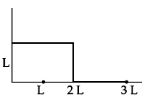
  • $\vec r\,cm = \frac{{13}}{8}L\hat x + \frac{5}{8}L\hat y$
  • B
    $\vec r\,cm = \frac{{5}}{8}L\hat x + \frac{13}{8}L\hat y$
  • C
    $\vec r\,cm = \frac{{3}}{8}L\hat x + \frac{11}{8}L\hat y$
  • D
    $\vec r\,cm = \frac{{11}}{8}L\hat x + \frac{3}{8}L\hat y$
Answer

Correct option: A.
$\vec r\,cm = \frac{{13}}{8}L\hat x + \frac{5}{8}L\hat y$
a
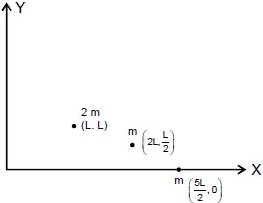
Three parts of rod can be considered as point masses.

${\overrightarrow r _{cm}} = \frac{{2m\,{{\overrightarrow r }_1} + m{{\overrightarrow r }_2} + m{{\overrightarrow r }_3}}}{{4\,m}}$

${\overrightarrow r _{cm}} = \frac{{2m\left( {L\hat i + L\hat j} \right) + m\left( {2L\hat i + \frac{L}{2}\hat j} \right) + m\left( {\frac{{5L}}{2}\hat i} \right)}}{{4\,m}}$

$ = \frac{{\frac{{13}}{2}L\hat i + \frac{5}{2}L\hat j}}{4}$

$ = \frac{{13}}{8}L\hat i + \frac{5}{8}L\hat j$


Need a full question paper?

Generate a complete, print-ready paper with questions like this in minutes — across 16+ boards, with answer keys.

Start Generating Free

Similar questions

The value of critical temperature in terms of Vander Waal’s constant $a$ and $b$ is
A tube of length $L$ is filled completely with an incompressible liquid of mass $M$ and closed at both the ends. The tube is then rotated in a horizontal plane about one of its ends with a uniform angular velocity $\omega $. The force exerted by the liquid at the other end is
A resonance tube is old and has jagged end. It is still used in the laboratory to determine velocity of sound in air. A tuning fork of frequency $512\,Hz$ produces first resonance when the tube is filled with water to a mark $11\,cm$ below a reference mark, near the open end of the tube. The experiment is repeated with another fork of frequency $256\,Hz$ which produces first resonance when water reaches a mark $27\,cm$ below the reference mark. The velocity of sound in air, obtained in the experiment, is close to .... $ms^{-1}$
In solids, inter$-$atomic forces are:
From the top of a tower of height $40m,$ a ball is projected upwards with a speed of $20\ m/ s$ at an angle of elevation of $30^\circ .$ The ratio of the total time taken by the ball to hit the ground to its time of flight time taken to come back to the same elevation is $($Take $g = 10\ m/ s^2)$
A satellite of mass $\mathrm{m}$ is launched vertically upwards with an initial speed $u$ from the surface of the earth. After it reaches height $\mathrm{R}$ ($R =$ radius of the earth), it ejects a rocket of mass $\frac{\mathrm{m}}{10}$ so that subsequently the satellite moves in a circular orbit. The kinetic energy of the rocket is

($G$ is the gravitational constant: $\mathrm{M}$ is the mass of the earth)

A bullet is fired vertically upwards with velocity $v$ from the surface of a spherical planet. When it reaches its maximum height, its acceleration due to the planet's gravity is $1 / 4^{\text {th }}$ of its value at the surface of the planet. If the escape velocity from the planet is $v_{e s c}=v \sqrt{N}$, then the value of $N$ is (ignore energy loss due to atmosphere)
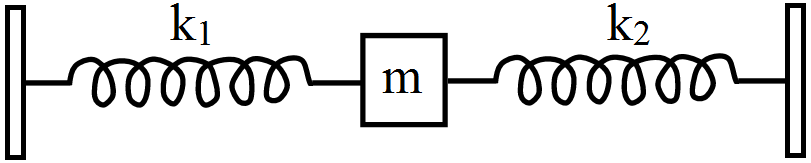
Two spring of force constants $k_1$ and $k_2$ are connected to a mass $m$ as shown in figure. The frequency of oscillation of the mass is $f.$ If both $k_1$ and $k_2$ are made four times their original values, the frequency of oscillation becomes
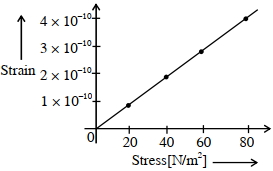
The elastic behaviour of material for linear streass and linear strain, is shown in the figure. The energy density for a linear strain of $5 \times 10^{-4}$ is $\dots \; kJ / m ^{3}$. Assume that material is elastic upto the linear strain of $5 \times 10^{-4}$.
The rotation period of an earth satellite close to the surface of the earth is $83$ minutes. The time period of another earth satellite in an orbit at a distance of three earth radii from its surface will be .......... $\min$