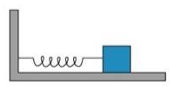
Question
The position, velocity and acceleration of a particle executing simple harmonic motion are found to have magnitudes $2cm, 1m/s$ and $10m/s^2$​​​​​​​ at a certain instant. Find the amplitude and the time period of the motion.

Answer

Given that, at a particular instant, $X = 2cm = 0.02m\ V = 1m/sec A = 10 m/s^2$ We know that $\text{a}=\omega^2\text{x}$
$\Rightarrow\omega=\sqrt{\frac{\text{a}}{\text{x}}}=\sqrt{\frac{10}{0.02}}=\sqrt{500}=10\sqrt{5}$
$\text{T}=\frac{2\pi}{\omega}=\frac{2\pi}{10\sqrt{5}}=\frac{2\times3.14}{10\times2.236}=0.28\text{ seconds.}$
Again, amplitude r is given by $\text{v}=\omega\Big(\sqrt{\text{r}^2-\text{x}^2}\Big)$
$\Rightarrow\text{v}^2=\omega^2(\text{r}^2-\text{x}^2)$
$1=500(\text{r}^2-0.0004)$
$\Rightarrow\text{r}=0.0489\approx0.049\text{m}$
$\therefore\text{r}=4.9\text{cm.}$

Need a full question paper?

Generate a complete, print-ready paper with questions like this in minutes — across 16+ boards, with answer keys.
Start Generating Free

Similar questions

The bottom of a dip on a road has a radius of curvature $R$. A rickshaw of mass $M$ left a little away from the bottom oscillates about the dip. Deduce an expression for the period of oscillation.
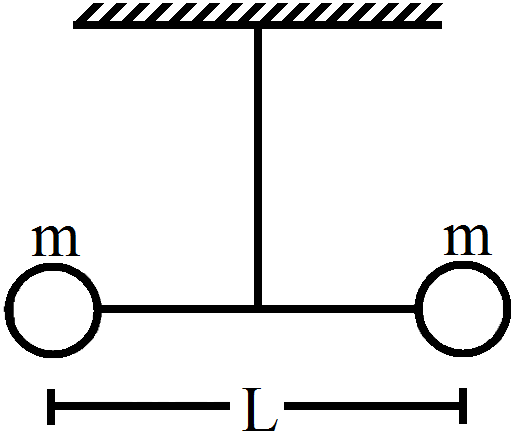
Two small balls, each of mass m are connected by a light rigid rod of length L. The system is suspended from its centre by a thin wire of torsional constant k. The rod is rotated about the wire through an angle $\theta_0$ and released. Find the tension in the rod' as the system passes through the mean position.
A metre long narrow bore held horizontally (and closed at one end) contains a 76cm long mercury thread, which traps a 15cm column of air. What happens if the tube is held vertically with the open end at the bottom?
In a room, where the temperature is 30°C, a body cools from 61°C to 59°C in 4 minute s. What time will the body take to cool from 51°C to 49°C in the same room?
One mole of an ideal gas undergoes a process $\text{p}=\frac{\text{p}_0}{1+\Big(\frac{\text{V}}{\text{V}_0}\Big)^2}$ where $P_0$ and $V_0$ are constants. Find the temperature of the gas when $V = V_0$.
A ball of mass m is dropped onto a floor from a certain height. The collision is perfectly elastic and the ball rebounds to the same height and again falls. Find the average force exerted by the ball on the floor during a long time interval.
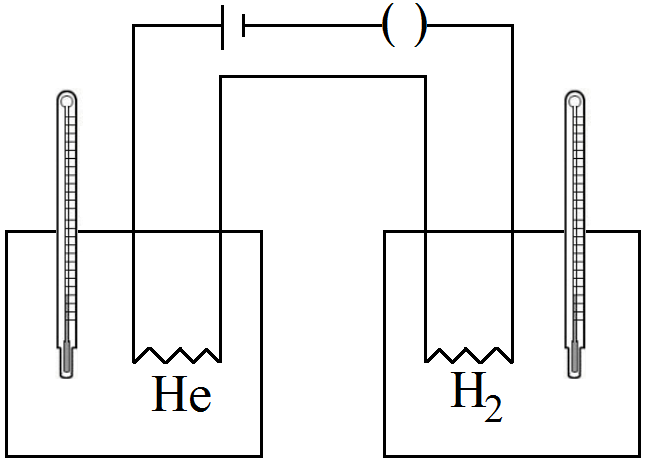
The figure shows two vessels with adiabatic walls, one containing 0.1g of helium $\big(\gamma=1.67,\text{M}=4\text{g-mol}^{-1}\big)$ and the other containing some amount of hydrogen $\big(\gamma=1.4,\text{M}=2\text{g-mol}^{-1}\big).$ Initially, the temperatures of the two gases are equal. The gases are electrically heated for some time during which equal amounts of heat are given to the two gases. It is found that the temperatures rise through the same amount in the two vessels. Calculate the mass of hydrogen.
What is a heat engine? What are its essential parts? Explain its principle and establish the formula for its efficiency.
A spring having with a spring constant $1200 N m ^{-1}$ is mounted on a horizontal table as shown in Fig. A mass of 3 kg is attached to the free end of the spring. The mass is then pulled sideways to a distance of 2.0 cm and released.
Image

Take the position of mass when the spring is unstreched as $x=0$, and the direction from left to right as the positive direction of $x$-axis. Give $x$ as a function of time $t$ for the oscillating mass if at the moment we start the stopwatch $(t=0)$, the mass is
a. at the mean position,
b. at the maximum stretched position, and
c. at the maximum compressed position.
In what way do these functions for SHM differ from each other, in frequency, in amplitude or the initial phase?
At what angle should a body be projected with a velocity $24 ms^{-1}$ just to pass over the obstacle 16 m high at a horizontal distance of 32 m ? Take $g =10 ms^{-2}$.