Question
What is a heat engine? What are its essential parts? Explain its principle and establish the formula for its efficiency.

Answer

SELF

Need a full question paper?

Generate a complete, print-ready paper with questions like this in minutes — across 16+ boards, with answer keys.

Start Generating Free

Similar questions

Three blocks are connected as shown on a horizontal frictionless table, and pulled to the right with a force of $T_3 = 60N$.
If $m_1 = 10kg, m_2 = 20kg$ and $m_3 = 30kg$. Prove that $\frac{\text{T}_1}{\text{T}_2}=\frac{1}{3}.$
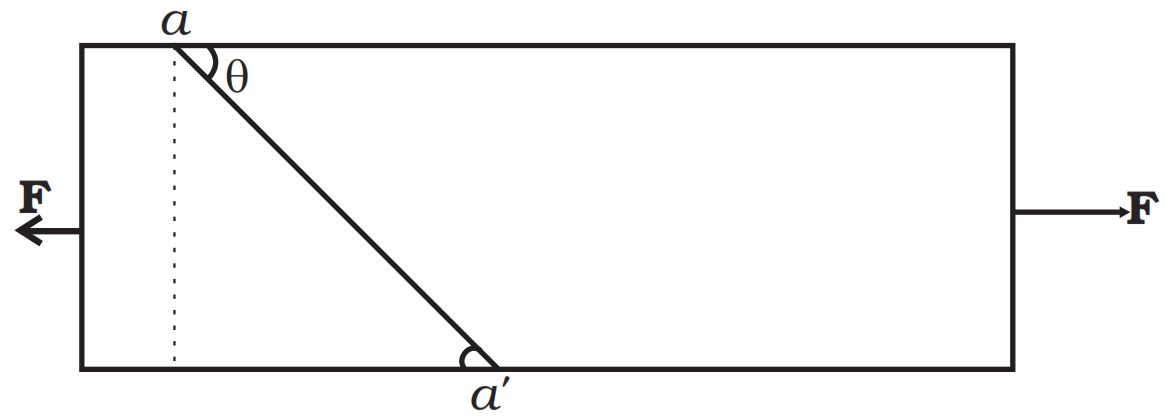
Consider a long steel bar under a tensile stress due to forces F acting at the edges along the length of the bar. Consider a plane making an angle $\Delta$ with the length. What are the tensile and shearing stresses on this plane?
  1. For what angle is the tensile stress a maximum?
  2. For what angle is the shearing stress a maximum?
Consider a situation similar to that of the previous problem except that the ends of the rod slide on a pair of thick metallic rails laid parallel to the wire. At one end the rails are connected by resistor of resistance R.
  1. What force is needed to keep the rod sliding at a constant speed v?
  2. In this situation what is the current in the resistance R?
  3. Find the rate of heat developed in the resistor.
  4. Find the power delivered by external agent exerting the force on the rod.
When the sun is directly overhead, the surface of the earth receives $1.4 \times 10^3 W m^{-2}$​​​​​​​ of sunlight. Assume that the light is monochromatic with average wavelength $500nm$ and that no light is absorbed in between the sun and the earth's surface. The distance between the sun and the earth is $1.5 \times 10^{11}m$.
  1. Calculate the number of photons falling per second on each square metre of earth's surface directly below the sun.
  2. How many photons are there in each cubic metre near the earth's surface at any instant?
  3. How many photons does the sun emit per second?
A satellite orbits the earth at a height of 400 km above the surface. How much energy must be expended to rocket the satellite out of the earth's gravitational influence? Mass of the satellite $=200 \mathrm{~kg}$; mass of the earth $=6.0 \times$ $10^{24} \mathrm{~kg}$; radius of the earth $=6.4 \times 10^6 \mathrm{~m} ; \mathrm{G}=6.67 \times 10^{-11} \mathrm{~N} \mathrm{~m}^2 \mathrm{~kg}^{-2}$.
The friction coefficient between the table and the block shown in figure is 0.2. Find the tensions in the two strings.
Two identical balls A and B undergo a perfectly elastic two dimensional collision. Initially A is moving with a speed of $10ms^{-1}$ and B is at rest. Due to collision A is scattered through angle of $30°$. What are the speed of A and B after the collision?
Explain two-dimensional motion by giving an example. Explain the displacement, velocity and acceleration of a particle in two-dimensional motion
An artificial satellite is revolving around a planet of mass M and radius R, in a circular orbit of radius r. From Kepler’s Third law about the period of a satellite around a common central body, square of the period of revolution T is proportional to the cube of the radius of the orbit r. Show using dimensional analysis, that $\text{T}=\frac{\text{k}}{\text{R}}\sqrt{\frac{\text{r}^3}{\text{g}}},$ where k is a dimensionless constant and g is acceleration due to gravity.
A ball of mass $100g$ and having a charge of $4.9 \times 10^{-5}C$ is released from rest in a region where a horizontal electric field of $2.0 \times 10^4NC^{-1}$ exists.
  1. Find the resultant force acting on the ball.
  2. What will be the path of the ball?
  3. Where will the ball be at the end of $2s$?