The possible value of Poisson's ratio is
Easy


Download our appand get started for free
Experience the future of education. Simply download our apps or reach out to us for more information. Let's shape the future of learning together!No signup needed.*
Similar Questions
- 1In an experiment, brass and steel wires of length $1\,m$ each with areas of cross section $1\,mm^2$ are used. The wires are connected in series and one end of the combined wire is connected to a rigid support and other end is subjected to elongation. The stress requires to produced a new elongation of $0.2\,mm$ is [Given, the Young’s Modulus for steel and brass are respectively $120\times 10^9\,N/m^2$ and $60\times 10^9\,N/m^2$ ]View Solution
- 2Given below are two statements: one is labelled as Assertion $A$ and the other is labelled as Reason $R$View Solution
Assertion $A$: Steel is used in the construction of buildings and bridges.
Reason $R:$ Steel is more elastic and its elastic limit is high.
In the light of above statements, choose the most appropriate answer from the options given below
- 3An elevator cable can have a maximum stress of $7 \times 10^7\,N/m^2$ for appropriate safety factors. Its maximum upward acceleration is $1.5\,m/s^2$ . If the cable has to support the total weight of $2000\,kg$ of a loaded elevator, the minimum area of crosssection of the cable should be ....... $cm^2$ $(g = 10\,m/s^2)$View Solution
- 4Two wires are made of the same material and have the same volume. However wire $1$ has crosssectional area $A$ and wire $2$ has cross-section area $3A$. If the length of wire $1$ increases by $\Delta x$ on applying force $F$, how much force is needed to stretch wire $2$ by the same amount?View Solution
- 5If the potential energy of a spring is $V$ on stretching it by $2\, cm$, then its potential energy when it is stretched by $10 \,cm$ will beView Solution
- 6A uniform rod of mass $m$, length $L$, area of cross-section $A$ and Young's modulus $Y$ hangs from the ceiling. Its elongation under its own weight will beView Solution
- 7View SolutionThe ratio of the adiabatic to isothermal elasticities of a triatomic gas is
- 8In a series combination of copper and steel wires of same length and same diameter, a force is applied at one of their ends while the other end is kept fixed. The combined length is increased by $2\, cm$. The wires will have ..........View Solution
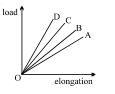
- 9View SolutionThe load versus strain graph for four wires of the same material is shown in the figure. The thickest wire is represented by the line
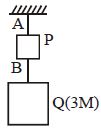
- 10Wires $A$ and $B$ are connected with blocks $P$ and $Q$ as shown. The ratio of lengths, radii and Young's modulus of wires $A$ and $B$ are $r, 2r$ and $3r$ respectively ($r$ is a constant). Find the mass of block $P$ if ratio of increase in their corresponding lengths is $1/6r^2$. The mass of block $Q$ is $3M$.View Solution