MCQ
The potassium ferrocyanide solution gives Prussian blue colour, when added to :
  • A
    $\mathrm{CoCl}_{3}$
  • B
    $\mathrm{FeCl}_{2}$
  • C
    $\mathrm{CoCl}_{2}$
  • $\mathrm{FeCl}_{3}$

Answer

Correct option: D.
$\mathrm{FeCl}_{3}$
d
$\left.\mathrm{FeCl}_{3}+\mathrm{K}_{4}\left[\mathrm{Fe}(\mathrm{CN})_{6}\right] \rightarrow \mathrm{Fe}_{4}[\mathrm{Fe}(\mathrm{CN})]_{6}\right]_{3}$

$\quad\quad\quad\quad\quad\quad\quad\quad\quad\quad\quad$Prussian blue

Need a full question paper?

Generate a complete, print-ready paper with questions like this in minutes — across 16+ boards, with answer keys.

Start Generating Free

Similar questions

In a Ostwald process

$N{H_3} + {O_2}\xrightarrow[{Pt}]{\Delta }x + {H_2}O$

${x} + {O_2} \to y$

$y + {H_2}O{\text{(excess)}} \to {\text{x + z}}$

The incorrect option is
At constant temperature, the osmotic pressure of a solution
Decomposition of $X$ exhibits a rate constant for $0.05\, \mu g/year$. How many years are required for the decomposition of $5\, \mu g$ of $X$ into $2.5\, \mu g$ ?
An optically active compound $X$ has molecular formula $C_4H_8O_3.$ It evolves $CO_2$ with $NaHCO_3.$  $'X' $ Reacts with $LiAlH_4$ to give an achiral compound. $'X'$ is
The value of 'spin only' magnetic moment for one of the following configuration is  $2.84\, BM.$ The correct one is
In which pair most efficient packing is present?
Among the species given below, the total number of diamagnetic species is. . . . .$\mathrm{H}$ atom, $\mathrm{NO}_2$ monomer, $\mathrm{O}_2^{-}$(superoxide), dimeric sulphur in vapour phase, $\mathrm{MnsO}_4$, $\left(\mathrm{NH}_4\right)_2\left[\mathrm{FeCl}_4\right],\left(\mathrm{NH}_4\right)_2\left[\mathrm{NiCl}_4\right], \mathrm{K}_2 \mathrm{MnO}_4, \mathrm{~K}_2 \mathrm{CrO}_4$
The protein which maintains blood sugar level in the human body
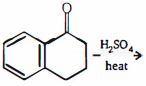
Which of the following is the major product from sulfonation of $\alpha$ -tetralone ?
Consider the following transformation involving first order elementary reaction in each step at constant temperature as shown below.

$\mathrm{A}+\mathrm{B} \underset{\text { Step } 3}{\text { Step } 1} \mathrm{C} \xrightarrow{\text { Step } 2} \mathrm{P}$

Some details of the above reaction are listed below.

Step

Rate constant $\left(\sec ^{-1}\right)$

Activation energy 

$\left(\mathrm{kJ} \mathrm{mol}^{-1}\right)$

$1$ ${k}_1$ $300$
$2$ ${k}_2$ $200$
$3$ ${k}_3$ $\mathrm{Ea}_3$

If the overall rate constant of the above transformation (k) is given as $\mathrm{k}=\frac{\mathrm{k}_1 \mathrm{k}_2}{\mathrm{k}_3}$ and the overall activation energy $\left(E_2\right)$ is $400 \mathrm{~kJ} \mathrm{~mol}^{-1}$, then the value of $\mathrm{Ea}_3$ is $\qquad$ $\mathrm{kJ} \mathrm{mol}^{-1}$ (nearest integer)
