A current $I$ is passing through a wire having two sections $P$ and $Q$ of uniform diameters $d$ and $d/2$ respectively. If the mean drift velocity of electrons in sections $P$ and $Q$ is denoted by $v_P$ and $v_Q$ respectively, then
Medium
Download our app for free and get started
(c) Drift velocity ${v_d} = \frac{i}{{neA}} \Rightarrow {v_d} \propto \frac{1}{A}{\rm{ or}}\,{v_d} \propto \frac{1}{{{d^2}}}$
$ \Rightarrow \,\frac{{{v_P}}}{{{v_Q}}} = {\left( {\frac{{{d_Q}}}{{{d_P}}}} \right)^2} = {\left( {\frac{{d/2}}{d}} \right)^2} = \frac{1}{4} \Rightarrow {v_P} = \frac{1}{4}{v_Q}$.

Download our appand get started for free
Experience the future of education. Simply download our apps or reach out to us for more information. Let's shape the future of learning together!No signup needed.*
Similar Questions
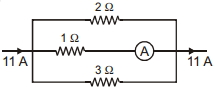
- 1The ammeter reading in the circuit below is .............. $A$View Solution
- 2View SolutionAn electric heater kept in vacuum is heated continuously by passing electric current. Its temperature
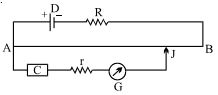
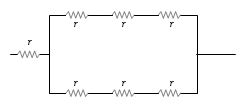
- 3View SolutionReferring to the figure below, the effective resistance of the network is
- 4View SolutionDiagram shows a circuit diagram choose incorrect statement
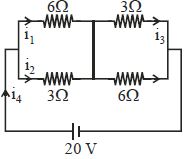
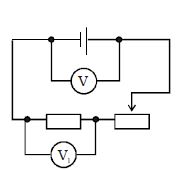
- 5If the rheostat slider were to move from the extreme right to the far left, How will the reading of voltmeter $V_1$ change?View Solution
- 6View SolutionIn meter bridge or Wheatstone bridge for measurement of resistance, the known and the unknown resistances are interchanged. The error so removed is
- 7A current of $5\; {A}$ is passing through a non-linear magnesium wire of cross-section $0.04\; {m}^{2}$. At every point the direction of current density is at an angle of $60^{\circ}$ with the unit vector of area of cross-section. The magnitude of electric field at every point of the conductor is ....${V} / {m}$ (Resistivity of magnesium is $\rho=44 \times 10^{-8}\, \Omega m$)View Solution
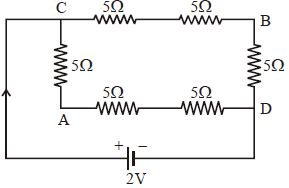
- 8In the adjoining circuit shown the potential difference between points $A$ and $B$ will beView Solution
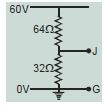
- 9Find potential of $J$ with : respect to $G -$ ............. $V$View Solution
- 10In the given potentiometer circuit, the resistance of the potentiometer wire $AB$ is $R_0$. $C$ is a cell of internal resistance $r$. The galvanometer $G$ does not give zero deflection for any position of the jockey $J$. Which of the following cannot be a reason for this?View Solution