Question
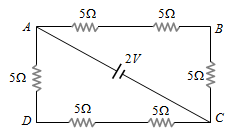
The potential difference between points A and B of adjoining figure is
(a) 
|
(b) 
|
(c) |
(d) 2 V |
The potential difference between points A and B of adjoining figure is
|
(a)
|
(b)
|
(c) |
(d) 2 V |
(c) 
Generate a complete, print-ready paper with questions like this in minutes — across 16+ boards, with answer keys.
The particles emitted by radioactive decay are deflected by magnetic field. The particles will be
|
(a) Protons and α - particles |
(b) Electrons, protons and α -particles |
|
(c) Electrons, protons and neutrons |
(d) Electrons and α -particles |
An electron is projected along the axis of a circular conductor carrying some current. Electron will experience force
|
(a) Along the axis |
(b) Perpendicular to the axis |
|
(c) At an angle of 4o with axis |
(d) No force experienced |
A 10  capacitor and a 20 capacitor are connected in series across a 200 V supply line. The charged capacitors are then disconnected from the line and reconnected with their positive plates together and negative plates together and no external voltage is applied. What is the potential difference across each capacitor
|
(a) |
(b) |
(c) 400 V |
(d) 200 V |
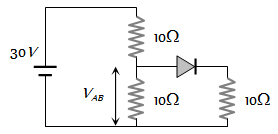
Find VAB
|
(a) 10 V |
(b) 20 V |
(c) 30 V |
(d) None of these |
A moving coil galvanometer has a resistance of 50 Ω and gives full scale deflection for 10 mA. How could it be converted into an ammeter with a full scale deflection for 1A
|
(a) 50/99 Ω in series |
(b) 50/99 Ω in parallel |
|
(c) 0.01 Ω in series |
(d) 0.01 Ω in parallel |
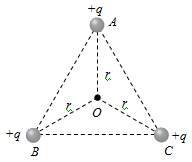
ABC is an equilateral triangle. Charges + q are placed at each corner. The electric intensity at O will be
|
(a) |
(b) |
(c) Zero |
(d) |
If two wires having resistance R and 2R. Both joined in series and in parallel then ratio of heat generated in this situation, applying the same voltage,
|
(a) 2 : 1 |
(b) 1 : 2 |
(c) 2 : 9 |
(d) 9 : 2 |


