MCQ
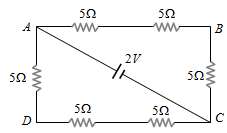
The potential difference between points A and B of adjoining figure is
  • A
    $\frac{2}{3} \mathrm{~V}$
  • B
    $\frac{8}{9} \mathrm{~V}$
  • $\frac{4}{3} \mathrm{~V}$
  • D
    $2 \mathrm{~V}$

Answer

Correct option: C.
$\frac{4}{3} \mathrm{~V}$
(c) $\frac{4}{3} \mathrm{~V}$

Need a full question paper?

Generate a complete, print-ready paper with questions like this in minutes — across 16+ boards, with answer keys.
Start Generating Free

Similar questions

Two solid conductors are made up of same material, have same length and same resistance. One of them has a circular cross section of area $A_{1}$ and the other one has a square cross section of area $A_{2}$. The ratio $\frac{A _{1}}{A _{2}}$ is
A complex current wave is given by $i = 5 + 5\, sin\, (100\, \omega t)\, A$. Its average value over one time period is given as.....$A$
Three long straight wires are connected parallel to each other across a battery of negligible internal resistance. The ratio of their resistances are $3 : 4 : 5$. What is the ratio of distances of middle wire from the others if the net force experienced by it is zero
In a region of constant potential:
If two conducting spheres are separately charged and then brought in contact
Following operations can be performed on a capacitor : $X$ - connect the capacitor to a battery of $emf$ $E.$ $Y$ - disconnect the battery $Z$ - reconnect the battery with polarity reversed. $W$ - insert a dielectric slab in the capacitor
A material is embedded between two glass plates. Refractive index $n$ of the material varies with thickness as shown below. The maximum incident angle (in degrees) on the material for which beam will pass through the material is
The $\beta$-particles of a radioactive metal originate from
The nuclei having same number of protons but different number of neutrons are called $......$.
Match List-$I$ with List-$II$ :-

List-$I$ $EM-Wave$

List-$II$ $Wavelength$ $Range$

$(A)$ infra-red $(i)$ $<10^{-3} \mathrm{~nm}$
$(B)$ Ultraviolet $(II)$ $400 \mathrm{~nm}$ to $1 \mathrm{~nm}$
$(C)$X-rays $(iii)$ $1 \mathrm{~mm}$ to $700 \mathrm{~nm}$
$(D)$ Gamma rays $(iv)$ $1 \mathrm{~nm}$ to $10^{-3} \mathrm{~nm}$

Choose the correct answer from the options given below: