MCQ
A complex current wave is given by $i = 5 + 5\, sin\, (100\, \omega t)\, A$. Its average value over one time period is given as.....$A$
  • A
    $10$
  • $5$
  • C
    $\sqrt {50} $
  • D
    $0$

Answer

Correct option: B.
$5$
b
${\rm{i}} = 5 + 5\sin \,(100\,\omega {\rm{t}})$

average value $<\mathrm{i}>=5+5<\sin (100\, \omega \mathrm{t})>$

In one time period $<\sin (100\, \omega t)>=0$

$<\mathrm{i}>=5 \mathrm{\,A}$

Need a full question paper?

Generate a complete, print-ready paper with questions like this in minutes — across 16+ boards, with answer keys.
Start Generating Free

Similar questions

A compound microscope has two lenses. The magnifying power of one is $5$ and the combined magnifying power is $100$. The magnifying power of the other lens is
The unit of electric field is not equivalent to:
When a piece of aluminium wire of finite length is drawn through a series of dies to reduce its diameter to half its original value, its resistance will become ........ times
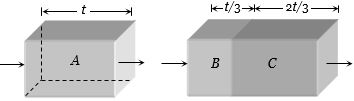
Two transparent slabs have the same thickness as shown. One is made of material $ A$  of refractive index $1.5.$ The other is made of two materials $B$ and $C$ with thickness in the ratio $1 : 2.$ The refractive index of $C$ is $1.6.$ If a monochromatic parallel beam passing through the slabs has the same number of waves inside both, the refractive index of $B$ is
An electron beam is accelerated by a potential difference $V$ to hit a metallic target to produce $X-$rays. It produces continuous as well as characteristic $X-$ rays.If $λ_{min}$ is the smallest possible wavelength of $X-$ray in the spectrum, the variation of log $log$ $λ_{min}$ with $log\ V$ is correctly represented in 
Larger aperture of objective lens in an astronomical telescope:
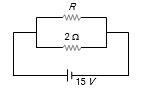
If in the circuit, power dissipation is $150\, W$, then $R$ is ............... $\Omega$
With what potential an electron should be accelerated so that its de Broglie wavelength becomes equal to the wavelength of first line of lymen series for $He^+$ ion ?
In a junction diode, the holes are due to
A sphere can roll on a surface inclined at an angle $\theta$ if the friction coefficient is more than $\frac{2}{7}\text{g}\tan \theta.$ Suppose the friction coefficient is $\frac{1}{7}\text{g}\tan \theta.$ If a sphere is released from rest on the incline: