MCQ
The potential difference between the two plates of a parallel plate capacitor is constant. When air between the plates is replaced by dielectric material, the electric field intensity:
- ADecreases
- BRemains unchanged
- CBecomes zero
- DIncreases
Explanation:
In general capacitance of parallel plate capacitor is given by:
$\text{C}=\frac{\text{K}\in_0\text{A}}{\text{d}}$
Where C is capacitance, k is relative permittivity of dielectric material, ϵ0 is permittivity of free space constant, A is area of plates and d is distance between them. Therefore, the capacitance of parallel plates is increased by the insertion of a dielectric material. Further, the capacitance is inversely proportional to the electric field between the plates, and hence the presence of the dielectric decreases the effective electric field.
Generate a complete, print-ready paper with questions like this in minutes — across 16+ boards, with answer keys.
A body has – 80 micro coulomb of charge. Number of additional electrons in it will be
|
(a) 8 |
(b) 80 |
(c) 5 |
(d) 1.28 |
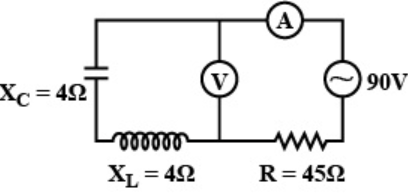
The half-life of radioactive Polonium (Po) is 138.6 days. For ten lakh Polonium atoms, the number of disintegrations in 24 hours is
|
(a) 2000 |
(b) 3000 |
(c) 4000 |
(d) 5000 |
Assertion : Mass of moving photon varies inversely as the wavelength.
Reason : Energy of the particle = Mass × 
|
(a) If both assertion and reason are true and the reason is the correct explanation of the assertion. |
|
(b) If both assertion and reason are true but reason is not the correct explanation of the assertion. |
|
(c) If assertion is true but reason is false. |
|
(d) If the assertion and reason both are false. |
A thin lens is made with a material having refractive index $\mu=1.5.$ Both the sides are convex. It is dipped in water $(\mu=1.33).$ It will behave like:
Assertion : Ultraviolet radiation are of higher frequency waves are dangerous to human being.
Reason : Ultraviolet radiation are absorbed by the atmosphere
|
(a) If both assertion and reason are true and the reason is the correct explanation of the assertion. |
|
(b) If both assertion and reason are true but reason is not the correct explanation of the assertion. |
|
(c) If assertion is true but reason is false. |
|
(d) If the assertion and reason both are false. |


