MCQ
 When electron remains between orbits, its momentum is:
  • A
    Quantized
  • B
    Dequantized
  • C
    Emitted
  • D
    Changed always

Answer

  1. Quantized

Explanation:

The first postulate of Bhor theory is that the orbital momentum of the electron is quantized ie, L = mvr = nh where h is Drac constant.

Need a full question paper?

Generate a complete, print-ready paper with questions like this in minutes — across 16+ boards, with answer keys.

Start Generating Free

Similar questions

Two bodies A and B having equal surface areas are maintained at temperatures 10°C and 20°C. The thermal radiation emitted in a given time by A and B are in the ratio:
  1. 1 : 1.15
  2. 1 : 2
  3. 1 : 4
  4. 1 : 16
In Young's double slit experiment, the interference pattern obtained with white light will be:
The color coding of  earth, live and neutral wire respectively is:
A proton and an electron are accelerated by the same potential difference. Let $\lambda_\text{e}$ and $\lambda_\text{p}$ denote the de Broglie wavelengths of the electron and the proton respectively.

  1. $\lambda_\text{e}=\lambda_\text{p}.$

  2. $\lambda_\text{e}<\lambda_\text{p}.$

  3. $\lambda _\text{e}>\lambda_\text{p}.$

  4. The relation between $\lambda_\text{e}$, and $\lambda_\text{p}$ depends on the accelerating potential difference.

The thickness of the depletion region is of the order of ___________ of a micrometre.
Which of the following pairs represent units of the same physical quantity?
  1. Kelvin and joule.
  2. Kelvin and calorie.
  3. Newton and calorie.
  4. Joule and calorie.
The surface that we choose for application of Gauss’s law is called as:

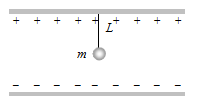
A small sphere carrying a charge ‘q’ is hanging in between two parallel plates by a string of length L. Time period of pendulum is . When parallel plates are charged, the time period changes to T . The ratio   is equal to

(a)

(b)

(c)

(d) None of these

In Bohr's model, the atomic radius of the first orbit is , then the radius of the third orbit is

(a)         

(b)  

(c)  

(d)  

On decreasing the distance between the plates of a parallel plate capacitor, its capacitance: