MCQ
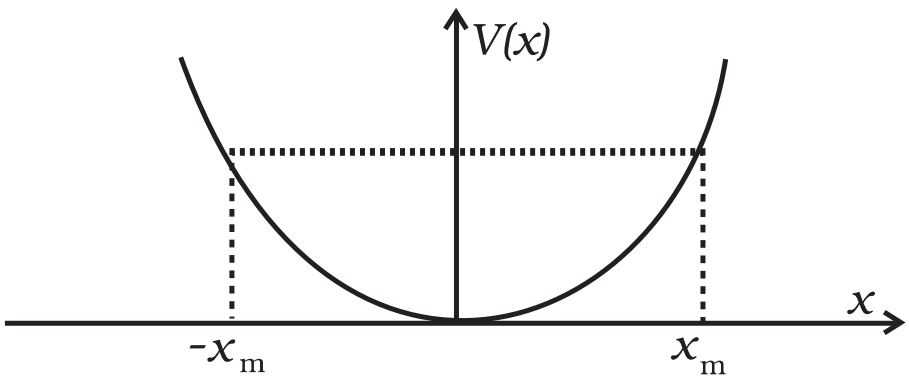
The potential energy function for a particle executing linear $\text{SHM}$ is given by $\text{v(x)}=\frac{1}{2}\text{kx}^2$ where $k$ is the force constant of the oscillator. For $k = 0.5N/ m,$ the graph of $V(x)$ versus $x$ is shown in the figure. A particle of total energy $E$ turns back when it reaches $\text{x}=\pm\text{x}_\text{m}.$ If $V$ and $K$ indicate the $P.E$. and $K.E.,$ respectively of the particle at $x = +xm,$ then which of the following is correct?
  • A
    $V = 0, K = E$
  • $V = E, K = 0$
  • C
    $V < E, K = 0$
  • D
    $V = 0, K < E$

Answer

Correct option: B.
$V = E, K = 0$
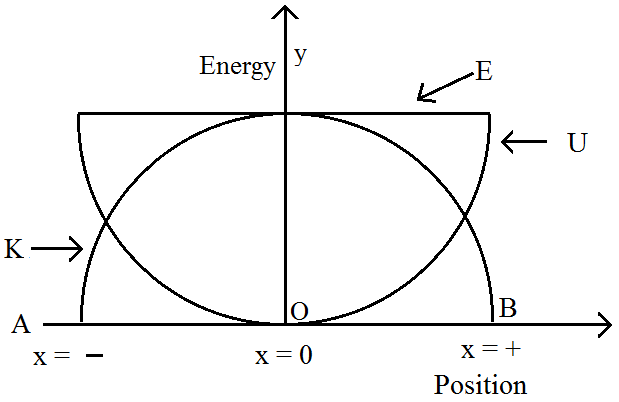
Key concept: Energy Graph for a Spring: If the mass attached with spring performs simple harmonic motion about its mean position then its potential energy at any position $(x)$ can be given by,

Now kinetic energy at any position $\text{K}=\text{E}-\text{U}=\frac{1}{2}\text{Ka}^2-\frac{1}{2}\text{Kx}^2$
$\text{K}=\frac{1}{2}(\text{a}^2-\text{x}^2)\ ....(\text{i})$
From the above formula, we can cheak that
$\text{U}_\text{max}=\frac{1}{2}\text{Ka}^2$
At extreme $x=\pm\text{a}\big]$ and $U_{min} = 0 [$At mean $x = 0]$
$\text{K}_\text{max}=\frac{1}{2}\text{Ka}^2 [$At mean $x = 0]$ and $K_{min} = 0 \big[$ At extreme $x=\pm\text{a}\big]$
$\text{E}=\frac{1}{2}​​\text{ka}^2=$ constant$($at all positions$)$
Because velocity of mass $= 0 [$at extreme position$]$
$\therefore\ \text{K}=\frac{1}{2}\text{mv}^2=0$
It means kinetic energy changes parabolically w.r.t. position but total energy remain always constant irrespective to the position of mass.
Total energy is $\text{E = PE + KE,}$ which remains constant.
According to the question, when paraticle is at $x = xm,$
i.e., at extreme position $\ce{x = xm \Rightarrow KE = 0}$
Hence, total energy will be
$\text{E}=\text{PE}+0=\text{PE}$
$\Rightarrow\text{V}\text{(x}_\text{m})=\frac{1}{2}\text{kx}^2_\text{m}$
Hence option $(b)$ is correct.
$\text{V = E, K = 0}$

Need a full question paper?

Generate a complete, print-ready paper with questions like this in minutes — across 16+ boards, with answer keys.

Start Generating Free

Similar questions

A particle moves from position $3\hat i + 2\hat j - 6\hat k$ to $14\hat i + 13\hat j + 9\hat k$ due to a uniform force of $(4\hat i + \hat j + 3\hat k)\,N.$ If the displacement in meters then work done will be.........$J$
According to kinetic theory of gases, which of following statement will be true.
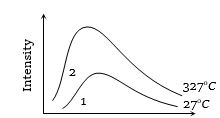
The spectrum of a black body at two temperatures $27^oC$ and $327^oC$ is shown in the figure. Let $A_1$ and $A_2$ be the areas under the two curves respectively. The value of $\frac{{{A_2}}}{{{A_1}}}$ is
A black body at a temperature of $127°C$ radiates heat at the rate of $1 cal/cm^2 × sec$. At a temperature of $527°C$ the rate of heat radiation from the body in ($cal/cm^2 × sec$) will be
A man of weight $W$ is standing on a lift which is moving downward with an acceleration $'a'$ . The apparent weight of the man is
A man is standing on a rough $(\mu = 0.5)$ horizontal disc rotating with constant angular velocity of $5$ $rad/sec.$ At what distance from centre should he stand so that he does not slip on the disc?
The maximum load a wire can withstand without breaking, when its length is reduced to half of its original length, will
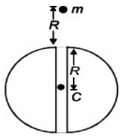
A particle of mass $m$ is dropped from a height $R$ equal to the radius of the earth above the tunnel dug through the earth as shown in the figure. Hence the correct statement is
The diameter of a sphere is measured using a vernier caliper whose $9$ divisions of main scale are equal to $10$ divisions of vernier scale. The shortest division on the main scale is equal to $1 \mathrm{~mm}$. The main scale reading is $2 \mathrm{~cm}$ and second division of vernier scale coincides with a division on main scale. If mass of the sphere is $8.635 \mathrm{~g}$, thedensity of the sphere $1 \mathrm{~s}$ :
A projectile is thrown with a velocity of $10\,m / s$ at an angle of $60^{\circ}$ with horizontal. The interval between the moments when speed is $\sqrt{5 g}\,m / s$ is $..........\,s$ $\left(g=10\,m / s ^2\right)$.