Question
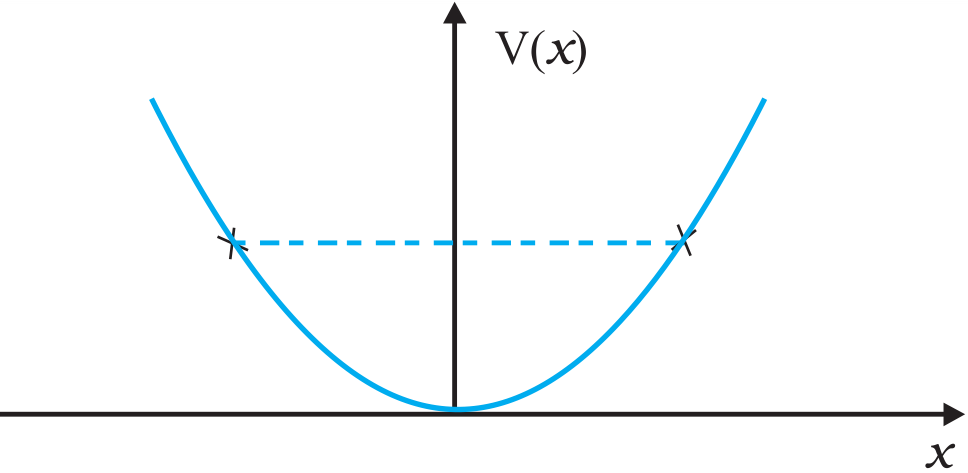
The potential energy function for a particle executing linear simple harmonic motion is given by $\text{V(x)} = \frac{\text{kx}^2}{2},$ where k is the force constant of the oscillator. For $k = 0.5Nm^{-1}$, the graph of V(x) versus x is shown in Show that a particle of total energy 1J moving under this potential must ‘turn back’ when it reaches $\text{x} =\pm 2\text{m}.$
Answer

Given, Potential energy for a particle executing linear simple harmonic motion is, $\text{V(x)}=\frac{1}{2}\text{kx}^2$
Where, $\text{k}=\frac{1}{2}\text{N/m}$

Total energy of particle $E = 1J$
Since at extreme position total energy is potential energy,
$\therefore\text{V}=\frac{1}{2}\text{kx}^2=1\text{J}$
$\Rightarrow\text{x}=\pm\sqrt{\frac{2}{\text{k}}}=\pm\sqrt{4}$
$\Rightarrow\text{x}=\pm2\text{m}$ Hence the results.

Need a full question paper?

Generate a complete, print-ready paper with questions like this in minutes — across 16+ boards, with answer keys.

Start Generating Free

Similar questions

The count rate from a radioactive sample falls from $4.0 \times 10^6$ per second to $1.0 \times 10^6$ per second in 20 hours. What will be the count rate 100 hours after the beginning?
Can an electromagnetic wave be polarised?
Molecules in air in the atmosphere are attracted by gravitational force of the earth. Explain why all of them do not fall into the earth just like an apple falling from a tree.
The magnetic field in a plane electromagnetic wave is given by $\text{B}=(200\mu\text{T})\sin\Big[\big(4.0\times10^{15}\text{s}^{-1}\big)\Big(\text{t}-\frac{\text{x}}{\text{c}}\Big)\Big]$ Find the maximum electric field and the average energy density corresponding to the electric field.
Calculate the ratio of the angular momentum of the earth about its axis due to its spinning motion to that about the sun due to its orbital motion. Radius of the earth = 6400km and radius of the orbit of the earth about the sun = $1.5 \times 10^8km$.
What is the analogue of mass in rotational motion? Derive the expression for the kinetic energy of a rotating body.
Iceberg floats in water with part of it submerged. What is the fraction of the volume of iceberg submerged if the density of ice is $\rho_\text{i}=0.917\text{g cm}^{-3}?$
Figure shows a small block of mass m which is started with a speed v on the horizontal part of the bigger block of mass M placed on a horizontal floor. The curved part of the surface shown is semicircular. All the surfaces are frictionless. Find the speed of the bigger block when the smaller block reaches the point A of the surface.
In a children's park, there is a slide which has a total length of $10m$ and a height of $8.0m ($figure$).$ Vertical ladder are provided to reach the top. A boy weighing $200N$ climbs up the ladder to the top of the slide and slides down to the ground. The average friction offered by the slide is three tenth of his weight. Find
  1. The work done by the ladder on the boy as he goes up.
  2. The work done by the slide on the boy as he comes down. Neglect any work done by forces inside the body of the boy.
A spring of force constant k has a mass M suspended from it. If the spring is cut into two halves, and the same mass is attached to one of the pieces, what will be the frequencies of oscillation of the mass?