Question
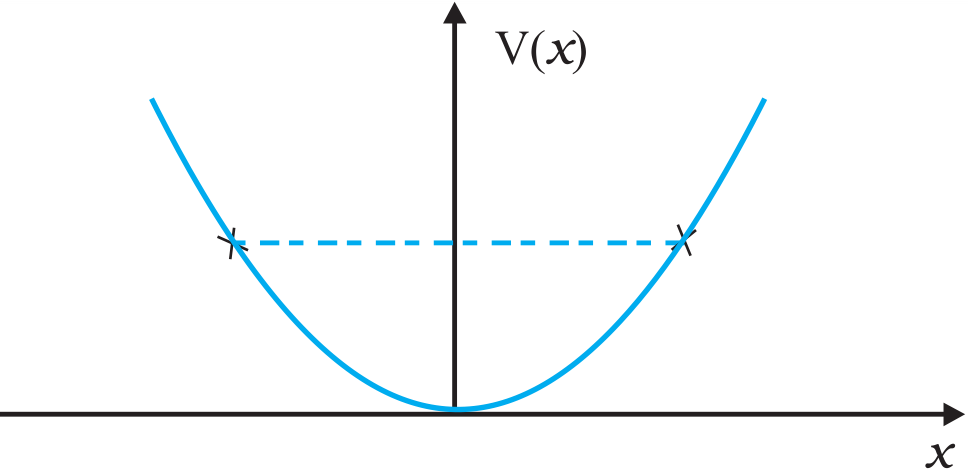
The potential energy function for a particle executing linear simple harmonic motion is given by $\text{V(x)} = \frac{\text{kx}^2}{2},$ where k is the force constant of the oscillator. For $k = 0.5Nm^{-1}$, the graph of V(x) versus x is shown in Show that a particle of total energy $1J$ moving under this potential must ‘turn back’ when it reaches $\text{x} =\pm 2\text{m}.$
Answer

Given, Potential energy for a particle executing linear simple harmonic motion is, $\text{V(x)}=\frac{1}{2}\text{kx}^2$ Where, $\text{k}=\frac{1}{2}\text{N/m}$

Total energy of particle E = 1J
Since at extreme position total energy is potential energy, $\therefore\text{V}=\frac{1}{2}\text{kx}^2=1\text{J}$ $\Rightarrow\text{x}=\pm\sqrt{\frac{2}{\text{k}}}=\pm\sqrt{4}$ $\Rightarrow\text{x}=\pm2\text{m}$ Hence the results.

Need a full question paper?

Generate a complete, print-ready paper with questions like this in minutes — across 16+ boards, with answer keys.

Start Generating Free

Similar questions

The current generator $I_g$ shown in figure, sends a constant current i through the circuit. The wire cd is fixed and ab is made to slide on the smooth, thick rails with a constant velocity v towards right. Each of these wires has resistance r. Find the current through the wire cd.
A ball bounces to $80\%$ of its original height. What fraction of its mechanical energy is lost in each bounce?
An air bubble of volume $1.0cm$ rises from the bottom of a lake $40m$ deep at a temperature of $12°C$. To what volume does it grow when it reaches the surface which is at a temperature of $35°C$?
From the top of a building 19.6m high, a ball is projected horizontally. After how long does it strike the ground? If the line joining the point of projection to the point where it hits the ground makes an angle of 45° with the horizontal, what is the initial velocity of the ball?
A block weighing 10N travels down a smooth curved track AB joined to a rough horizontal surface (figure). The rough surface has a friction coefficient of 0.20 with the block. If the block starts slipping on the track from a point 1.0m above the horizontal surface, how far will it move on the rough surface?
A man can swim with a speed of $4.0km/h$ in still water. How long does he take to cross a river $1.0km$ wide if the river flows steadily at $3.0km/h$ and he makes his strokes normal to the river current? How far down the river does he go when he reaches the other bank?
Define Coefficient of Thermal Conductivity and derive its SI unit. Calculate the rate of loss of heat through a glass window of area $1000 cm^2$ and thickness $0.4 cm$ when temperature inside is $37^\circ C$ and outside is $-5^\circ C$. Coefficient of thermal conductivity of glass is $2.2 \times 10^{-3}cal \  s^{-1}\ cm^{-1}\ K^{-1}$.
Explain why: An optical pyrometer (for measuring high temperatures) calibrated for an ideal black body radiation gives too low a value for the temperature of a red hot iron piece in the open, but gives a correct value for the temperature when the same piece is in the furnace.
Discuss graphical method for the measurement of impulse in the following case:
  1. When constant force acts on the body.
  2. When a variable force acts on the body.
A particle moves in a circle of radius $1.0\ cm$ at a speed given by $v = 2.0t$ where $v$ is in $cm/s$ and $t$ in seconds.
  1. Find the radial acceleration of the particle at $t = 1s.$
  2. Find the tangential acceleration at $t = 1s.$
  3. Find the magnitude of the acceleration at $t = 1s.$