Question
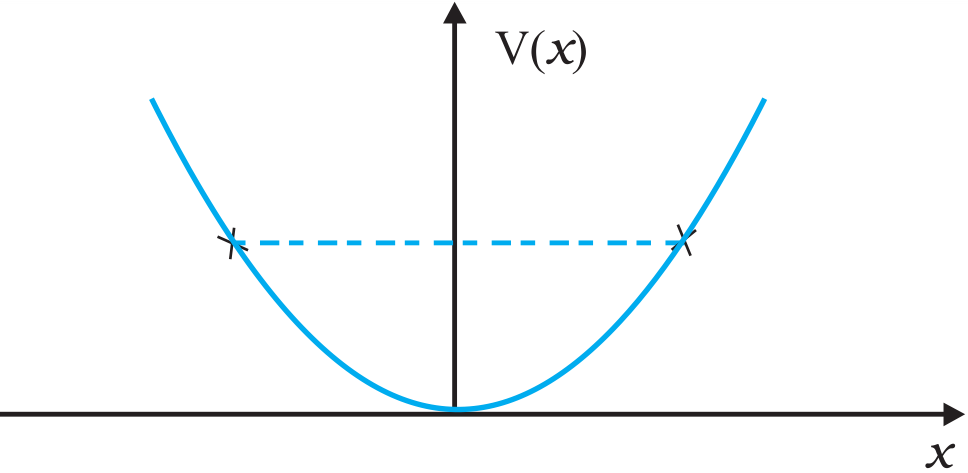
The potential energy function for a particle executing linear simple harmonic motion is given by $\text{V(x)} = \frac{\text{kx}^2}{2},$ where k is the force constant of the oscillator. For k = 0.5Nm-1, the graph of V(x) versus x is shown in Show that a particle of total energy 1J moving under this potential must ‘turn back’ when it reaches $\text{x} =\pm 2\text{m}.$
Answer

Given,

Potential energy for a particle executing linear simple harmonic motion is, 

$\text{V(x)}=\frac{1}{2}\text{kx}^2$

Where, $\text{k}=\frac{1}{2}\text{N/m}$

Total energy of particle E = 1J

Since at extreme position total energy is potential energy,

$\therefore\text{V}=\frac{1}{2}\text{kx}^2=1\text{J}$

$\Rightarrow\text{x}=\pm\sqrt{\frac{2}{\text{k}}}=\pm\sqrt{4}$

$\Rightarrow\text{x}=\pm2\text{m}$

Hence the results.

Need a full question paper?

Generate a complete, print-ready paper with questions like this in minutes — across 16+ boards, with answer keys.

Start Generating Free

Similar questions

Given the moment of inertia of a disc of mass M and radius R about any of its diameters to be $\frac{\text{MR}^2}{4},$ find its moment of inertia about an axis normal to the disc and passing through a point on its edge.
Consider a sunlike star at a distance of 2 parsecs. When it is seen through a telescope with 100 magnification, what should be the angular size of the star? Sun appears to be $\Big(\frac{1}{2}\Big)^0$ from the earth. Due to atmospheric fluctuations, eye can’t resolve objects smaller than 1 arc minute.
A particle executes the motion described by $\text{x}(\text{t})=\text{x}_0(1-\text{e}^{-\gamma\text{t}});\text{t}\ge0,\text{x}_0>0.$
Find maximum and minimum values of x(t), v(t), a(t). Show that x(t) and a(t) increase with time and v(t) decreases with time.
The heat current is written as $\frac{\triangle\text{Q}}{\triangle\text{t}}.$ Why don't we write $\frac{\text{dQ}}{\text{dt}}?$
Two wires of different densities but same area of crosssection are soldered together at one end and are stretched to a tension T. The velocity of a transverse wave in the first wire is double of that in the second wire. Find the ratio of the density of the first wire to that of the second wire.
Find the angle of deviation suffered by the light ray shown in figure. The refractive index $\mu=1.5$ for the prism material.

The flow rate of water from a tap of diameter 1.25 cm is $0.48 \frac{L}{ min }$. The coefficient of viscosity of water is $10^{-3}$ Pa s. After some time the flow rate is increased to $3 L / min$. Characterise the flow for both the flow rates.
On what parameter does the $\lambda$ (mean free path) depends?
State with reasons, whether the following algebraic operations with scalar and vector physical quantities are meaningful :
(a) adding any two scalars, (b) adding a scalar to a vector of the same dimensions, (c) multiplying any vector by any scalar, (d) multiplying any two scalars, (e) adding any two vectors, (f) adding a component of a vector to the same vector.
A ball of mass m, moving with a speed 2v0, collides inelastically (e > 0) with an identical ball at rest. Show that:
For head-on collision, both the balls move forward.