Question
On what parameter does the $\lambda$ (mean free path) depends?

Answer

We know that:

$\lambda=\frac{\text{kT}}{\sqrt{2}\pi\text{d}^2\rho}=\frac{\text{m}}{\sqrt{2}\pi\text{d}^2\rho}=\frac{1}{\sqrt{2}\pi\text{n}\text{d}^2}$

$\therefore\lambda$ depends upon:

  1. Diameter (d) of the molecule, smaller the 'd', larger is the mean free path $\lambda.$

  2. $\lambda\propto\text{T}$ i.e., higher the temperature larger is the $\lambda.$

  3. $\lambda\propto\frac{1}{\text{P}}$ i.e., smaller the pressure larger is the $\lambda.$

  4. $\lambda\propto\frac{1}{\text{P}}$ i.e., smaller the density $(\rho)$ larger will be the $\lambda.$

  5. $\lambda\propto\frac{1}{\text{P}}$ i.e., smaller the number of molecules per unit volume of the gas, larger is the $\lambda.$

Need a full question paper?

Generate a complete, print-ready paper with questions like this in minutes — across 16+ boards, with answer keys.
Start Generating Free

Similar questions

A Carnot engine absorbs 1000J of heat energy from a reservoir at 12.7°C and rejects 600J of heat energy during each cycle. Calculate. (i) efficiency of the engine, (ii) temperature of sink, (iii) amount of useful work done per cycle.
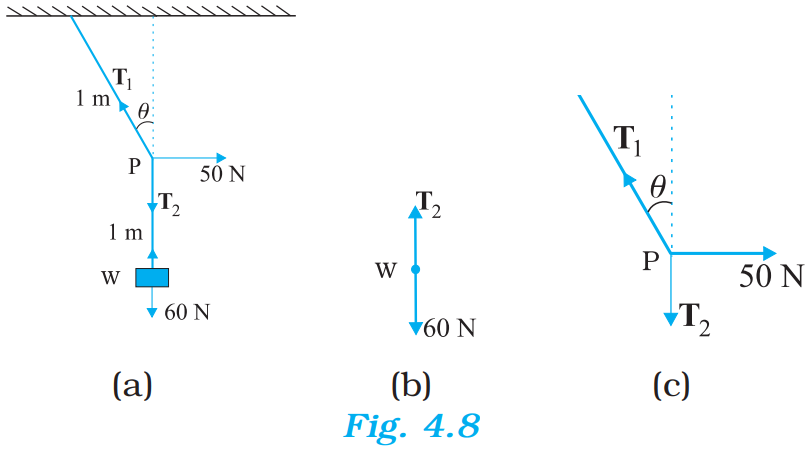
See Fig. 4.8. A mass of $6 kg$ is suspended by a rope of length $2 m$ from the ceiling. A force of $50 N$ in the horizontal direction is applied at the midpoint $P$ of the rope, as shown. What is the angle the rope makes with the vertical in equilibrium? (Take $g=10 m s ^{-2}$ ). Neglect the mass of the rope.
Image
Given a + b + c + d = 0, which of the following statements are correct:
The magnitude of (a + c) equals the magnitude of ( b + d).
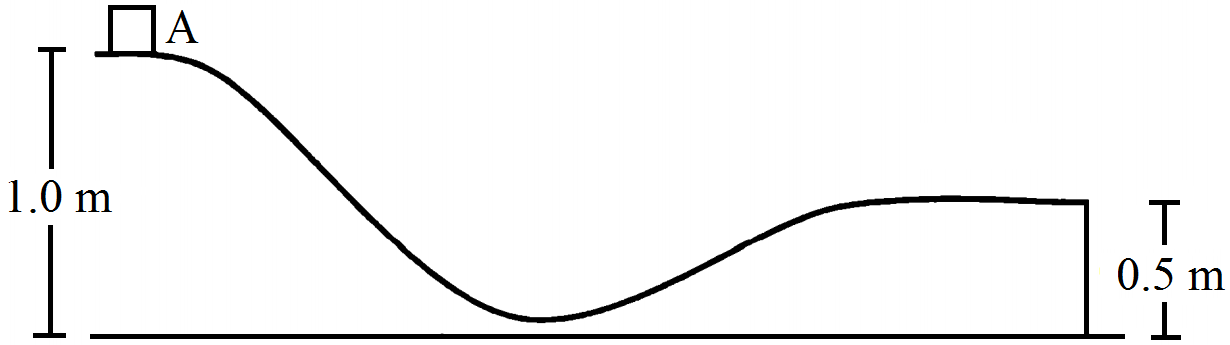
Figure shows a particle sliding on a frictionless track which terminates in a straight horizontal section. If the particle starts slipping from the point A, how far away from the track will the particle hit the ground?

Compute the mass of a planet that has a satellite whose time period is T and orbital radius is r.
What is Simple Harmonic Motion? Show that in S.H.M., acceleration is directly proportional to its displacement at a given instant.
Derive a relation for the time taken by a projectile to reach the highest point and the maximum height attained?
Just as precise measurements are necessary in science, it is equally important to be able to make rough estimates of quantities using rudimentary ideas and common observations. Think of ways by which you can estimate the following (where an estimate is difficult to obtain, try to get an upper bound on the quantity):
The mass of an elephant.
A molecule. of hydrogen contains two protons and two electrons. The nuclear force between these two protons is always neglected while discussing the behaviour of a hydrogen molecule. Why?
If the horizontal range of projectile be a and the maximum height attained by it is b, then prove that the velocity of projectile is $\Big[2\text{g}\Big(\text{b}+\frac{\text{a}^2}{16\text{b}}\Big)\Big]^\frac{1}{2}.$