MCQ
The potential energy of a particle of mass $m$ at a distance $r$ from a fixed point $O$ is given by $\mathrm{V}(\mathrm{r})=\mathrm{kr}^2 / 2$, where $\mathrm{k}$ is a positive constant of appropriate dimensions. This particle is moving in a circular orbit of radius $\mathrm{R}$ about the point $\mathrm{O}$. If $\mathrm{v}$ is the speed of the particle and $\mathrm{L}$ is the magnitude of its angular momentum about $\mathrm{O}$, which of the following statements is (are) true?

$(A)$ $v=\sqrt{\frac{k}{2 m}} R$

$(B)$ $v=\sqrt{\frac{k}{m}} R$

$(C)$ $\mathrm{L}=\sqrt{\mathrm{mk}} \mathrm{R}^2$

$(D)$ $\mathrm{L}=\sqrt{\frac{\mathrm{mk}}{2}} \mathrm{R}^2$

  • A
    $A,C$
  • $B,C$
  • C
    $A,D$
  • D
    $A,C,D$

Answer

Correct option: B.
$B,C$
b
The potential energy of the particle is,

$\mathrm{V}=\frac{\mathrm{kr}^2}{2}$

$\because \mathrm{F}=-\frac{\mathrm{dv}}{\mathrm{dr}} \quad \therefore \mathrm{F}=-\mathrm{kr}$

(imag)

$\text { At } \mathrm{r}=\mathrm{R}, \mathrm{F}=-\mathrm{kR}$

To keep the particle in circular motion, this force must be equal to centripetal force. So, $k R=\frac{\mathrm{mv}^2}{\mathrm{R}} \quad$ or $\quad v=\sqrt{\frac{k R^2}{m}}=\sqrt{\frac{k}{m}} \cdot R$

The angular momentum of the particle is, $\mathrm{L}=\mathrm{mvR}=\mathrm{m} \sqrt{\frac{\mathrm{k}}{\mathrm{m}}} \cdot \mathrm{R}^2$

Need a full question paper?

Generate a complete, print-ready paper with questions like this in minutes — across 16+ boards, with answer keys.

Start Generating Free

Similar questions

Which of the following statements about kinetic theory of gases is wrong
Two vectors $\vec A$ and $\vec B$ have equal magnitudes. The magnitude of $(\vec A + \vec B)$ is $‘n’$ times the magnitude of $(\vec A - \vec B)$. The angle between $ \vec A$ and $\vec B$ is
A force $\overrightarrow F = (5\hat i + 4\hat j)$ $N $ acts on a body and produces a displacement $\overrightarrow S = (6\hat i - 5\hat j + 3\hat k)$ $m$ . The work done will be......$J$
Which one of the following statements is true?
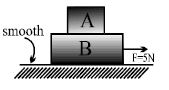
In the shown arrangement mass of $A = 1\,\,kg$  mass of  $B = 2\,\,kg.$  Coefficient of friction between $A $ and $B = 0.2.$  There is no friction between $B$  and ground. The frictional force exerted by $A$ on $B$ equals to
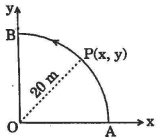
A point $P$ moves in counter-clockwise direction on a circular path as shown in the figure. The movement of '$P$' is such that it sweeps out a length  $s = t^3+5$, where s is in metres and $t$ is in seconds. The radius of the path is $20\ m$. The acceleration of '$P$' when $t = 2\ s$ is nearly ..........  $m/s^2$
If $I_1$ is the moment of inertia of a thin rod about an axis perpendicular to its length and passing through its centre of mass, and $I_2$ is the moment of inertia of the ring formed by bending the rod, then
With the usual notations, the following equation ${S_t} = u + \frac{1}{2}a(2t - 1)$ is
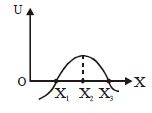
In the figure shown the potential energy $(U)$ of a particle is plotted against its position $'x'$ from origin. The particle at
The acceleration of a particle performing S.H.M. is at a distance of $3\; cm$ from the mean position is $ 12\,cm/sec^2 $. Its time period is ..... $\sec$