MCQ
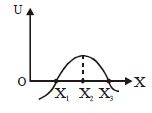
In the figure shown the potential energy $(U)$ of a particle is plotted against its position $'x'$ from origin. The particle at
  • A
    $x_1$ is in stable equilibrium
  • B
    $x_2$ is in stable equilibrium
  • C
    $x_3$ is in stable equilibrium
  • None of these

Answer

Correct option: D.
None of these
d
$P.E.$ $\to $ Maximum $\to $ Unstable equilibrium
$P.E.$ $\to $ Minimum $\to $ Stable equilibrium
$P.E.$ $\to $ Constant $\to $ Neutral equilibrium
$\therefore $ None of these

Need a full question paper?

Generate a complete, print-ready paper with questions like this in minutes — across 16+ boards, with answer keys.
Start Generating Free

Similar questions

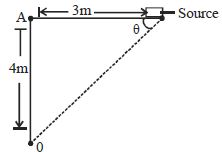
A source of sound is travelling at $\frac{{100}}{3}\,m/\sec $ along a road, towards a point $A$, when the source is $3\, m$ away from $A$, a person standing at a point $O$ on a road at perpendicular position. The distance of $O$ from $A$ at that time is $4\,m$. If the original frequency is $640\, Hz$,then the value of apperent frequency listen by person is  ...... $Hz$ (speed of sound is $340\, m/sec$)
The escape velocity on earth is $11.2 \,km/s$. On another planet having twice radius and $8$ times mass of the earth, the escape velocity will be ......... $km/s$
The magnitude of vector $\overrightarrow A ,\,\overrightarrow B $ and $\overrightarrow C $ are respectively $12, 5$ and $13$ units and $\overrightarrow A + \overrightarrow B = \overrightarrow C $ then the angle between $\overrightarrow A $ and $\overrightarrow B $ is
Displacement between two points is $. . . . . .$
The mean state of simple harmonic motion will be :
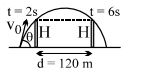
A projectile crosses two walls of equal height $H$ symmetrically as shown If the horizontal distance between the two walls is $d = 120\,\, m$, then the range of the projectile is ........ $m$
A box weighs $196 \;\mathrm{N}$ on a spring balance at the north pole. Its weight recorded on the same balance if it is shifted to the equator is close to ....... $N$

(Take $\mathrm{g}=10\; \mathrm{ms}^{-2}$ at the north pole and the radius of the earth $=6400\; \mathrm{km}$)
Calculate the work done, if a wire is loaded by $'Mg'$ weight and the increase in length is $'l'$
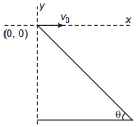
A man standing on a hill top projects a stone horizontally with speed $v_0$ as shown in figure. Taking the coordinates system as given in the figure. The coordinates of the point, where the stone will hit the hill surface are
A long horizontal rod has a bead which can slide along its length, and initially placed at a distance $L$ from one end $A$ of the rod. The rod is set in angular motion about $A$ with constant angular acceleration $\alpha$. If the coefficient of friction between the rod and the bead is $\mu$, and gravity is neglected, then the time after which the bead starts slipping is