MCQ
The potential energy of a particle varies with distance $x$ from a fixed origin as $U\, = \,\frac{{A\sqrt x }}{{{x^2} + B}}$ Where $A$ and $B$ are dimensional constants then find the dimensional formula for $A/B$
  • A
    ${M^2}{L^1}{T^{ - 2}}$
  • ${M^1}{L^{3/2}}{T^{ - 2}}$
  • C
    ${M^0}{L^{1/5}}{T^{ - 3}}$
  • D
    ${M^2}{L^{2/2}}{T^{ - 3}}$

Answer

Correct option: B.
${M^1}{L^{3/2}}{T^{ - 2}}$
b
$[\mathrm{B}]=\left[\mathrm{x}^{2}\right]=\mathrm{L}^{2}$

$[\mathrm{U}]=\frac{[\mathrm{A}][\mathrm{x}]^{1 / 2}}{[\mathrm{x}]^{2}}=\frac{[\mathrm{A}]}{[\mathrm{x}]^{3 / 2}} \Rightarrow[\mathrm{A}]=[\mathrm{u}][\mathrm{x}]^{3 / 2}$

$=\mathrm{MI}^{2} \mathrm{T}^{-2} \times \mathrm{L}^{3 / 2}$

$[\mathrm{A}]=\mathrm{ML}^{7 / 2} \mathrm{T}^{-2}$

$\left[\frac{\mathrm{A}}{\mathrm{B}}\right]=\frac{\mathrm{ML}^{7 / 2} \mathrm{T}^{-2}}{\mathrm{L}^{2}}$

$[\mathrm{A} / \mathrm{B}]=\mathrm{ML}^{3 / 2} \mathrm{T}^{-2}$

Need a full question paper?

Generate a complete, print-ready paper with questions like this in minutes — across 16+ boards, with answer keys.

Start Generating Free

Similar questions

A particle of mass $m$ executes simple harmonic motion with amplitude $a$ and frequency $v$. The average kinetic energy during its motion from the position of equilibrium to the end is
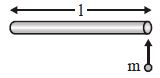
A stick of length $l$ and mass $M$ lies on a frictionless horizontal surface on which it is free to move in any way. A ball of mass $m$ moving with speed $v$ collides elastically with the stick as shown in the figure. If after the collision ball comes to rest, then what should be the mass of the ball
If the light moving in a straight line bends by a small but fixed angle, it may be a case of:
  1. Reflection.
  2. Refraction.
  3. Diffraction.
  4. Dispersion.
The torque of a force $5 \hat{i}+3 \hat{j}-7 \hat{k}$ about the origin is $\tau$. If the force acts on a particle whose position vector is $2 \hat{i}+2 \hat{j}+\hat{k}$, then the value of $\tau$ will be.
Force acting on a particle moving in a straight line varies with the velocity of the particle as $F = \frac {K}{v}$ . Here $K$ is a constant. The work done by this force in time $t$ is 
You lift a suitcase from the floor and keep it on a table. The work done by you on the suitcase does not depend on:
A body of mass $M$ at rest explodes into three pieces, in the ratio of masses $1: 1: 2$. Two smaller pieces fly off perpendicular to each other with velocities of $30 \,ms ^{-1}$ and $40 \,ms ^{-1}$ respectively. The velocity of the third piece will be ............... $\,ms ^{-1}$
A hot body will radiate heat most rapidly if its surface is
The reactance of a circuit is zero. It is possible that the circuit contains:
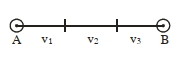
A car covers $A B$ distance with first one-third at velocity $v _{1} ms ^{-1}$, second one-third at $v _{2} ms ^{-1}$ and last one-third at $v _{3} ms ^{-1}$. If $v _{3}=3 v _{1}, v _{2}=2 v _{1}$ and $v _{1}=11\,ms ^{-1}$ then the average velocity of the car is________ $ms ^{-1} .$