MCQ
The potential energy per unit volume of a stretched wire is:
  • A
    $\frac{1}{2} \times$ Stress $\times$ Strain $^2$
  • B
    $\frac{1}{2} \frac{\text { Stress }}{\text { Strain }}$
  • $\frac{1}{2} \times$ Young Modulus of Elasticity $\times$ Strain $^2$
  • D
    $\frac{1}{2} \times$ Young Modulus of Elasticity $\times$ Strain.
Answer

Correct option: C.
$\frac{1}{2} \times$ Young Modulus of Elasticity $\times$ Strain $^2$
C

Need a full question paper?

Generate a complete, print-ready paper with questions like this in minutes — across 16+ boards, with answer keys.

Start Generating Free

Similar questions

For a given velocity, a projectile has the same range $R$ for two angles of projection if $t_1$ and $t_2$ are the times of flight in the two cases then
The period of a satellite in a circular orbit of radius $R$ is $T$, the period of another satellite in a circular orbit of radius $4R$ is
$10\; gm$ of ice cubes at $0\;^{\circ} C$ are released in a tumbler (water equivalent $55\; g$ ) at $40\;^{\circ} C$. Assuming that negligible heat is taken from the surroundings, the temperature(in $^o C$) of water in the tumbler becomes nearely $(L_f=80\; cal / g )$
A liquid drop of diameter $D$ breaks upto into $27$ small drops of equal size. If the surface tension of the liquid is $\sigma$, then change in surface energy is
Water is flowing steadily through a horizontal tube of non uniform cross-section. If the pressure of water is $4$ $\times $ $10^4$ $N/m^2$ at a point where cross-section is $0.02$ $m^2$ and velocity of flow is $2$ $m/s$, what is pressure at a point where cross-section reduces to $0.01$ $m^2$.
A carnot engine is made to work between $200\,^oC$ and $0\,^oC$ first and then between $0\,^oC$ and $-200\,^oC$. The ratio of efficiencies $\left( {\frac{{{\eta _2}}}{{{\eta _1}}}} \right)$ of the engine in two cases is
The mass and diameter of a planet are twice those of earth. The period of oscillation of pendulum on this planet will be (If it is a second's pendulum on earth)
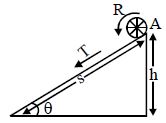
Suppose a body of mass $M$ and radius $R$ is allowed to roll on an inclined plane without slipping from its topmost point $A$. The velocity acquired by the body, as it reaches the bottom of the inclined plane, is given by $\beta  = 1 + \frac{I}{{M{R^2}}}$
Two blocks $A$ and $B$ of masses $5 \,kg$ and $3 \,kg$ respectively rest on a smooth horizontal surface with $B$ over $A$. The coefficient of friction between $A$ and $B$ is $0.5$. The maximum horizontal force (in $kg$ wt.) that can be applied to $A$, so that there will be motion of $A$ and $B$ without relative slipping, is
Two particles of equal mass $m$ go around a circle of radius $R$ under the action of their mutual gravitational attraction. The speed of each partial with respect to their centre of mass is