MCQ
The potential function of an electrostatic field is given by $V = 2x^2$. Determine the electric field strength at the point $(2\,m, 0, 3\,m)$
  • A
    $\vec E = 4\hat i\left( {N{C^{ - 1}}} \right)$
  • B
    $\vec E =  - 4\hat i\left( {N{C^{ - 1}}} \right)$
  • C
    $\vec E =  8\hat i\left( {N{C^{ - 1}}} \right)$
  • $\vec E =  - 8\hat i\left( {N{C^{ - 1}}} \right)$
Answer

Correct option: D.
$\vec E =  - 8\hat i\left( {N{C^{ - 1}}} \right)$
d
$\mathrm{E}=-\frac{\mathrm{dV}}{\mathrm{dx}}=-(4 \mathrm{x}) \hat{\mathrm{i}}$

$\mathrm{E}=-4(2)=-8 \hat{\mathrm{i}}$

Need a full question paper?

Generate a complete, print-ready paper with questions like this in minutes — across 16+ boards, with answer keys.

Start Generating Free

Similar questions

A square frame of side I carries a current $i$. The magnetic field at its centre is $B$. The same current is passed through a circular coil having the same perimeter as the square. The field at the centre of the circular coil is $B^{\prime}$. The ratio of $\frac{B}{B^{\prime}}$ is
A resistor $R$, an inductor $L$ and $a$ capacitor $C$ are connected in series to an oscillator of frequency $n$. if the resonant frequency is ${n_r}$, then the current lags behind voltage, when
If both the object and image are at infinite distances form a refracting telescope its magnifying power will be equal to
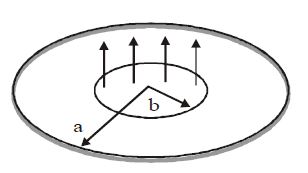
A line charge ( $\lambda $ per unit length) is in the form of circular wheel of radius $'a'$ and moment of inertia is $I$ , initial at rest. It is free to rotate in a horizontal plane. There is a coaxial magnetic field $B = {B_0}\hat k$ extending upto a radius $b(b < a)$ . If the magnetic field is switched off, the angular velocity $'\omega '$ of the wheel is given by
The dipole moment per unit volume is called as:
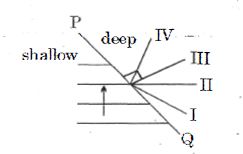
Figure, shows wave fronts in still water moving in the direction of the arrow towards the interface $PQ$ between a shallow region and a deep(denser) region. Which of the lines shown may represent one of the wave fronts in the deep region?
The resistance of a wire of uniform diameter d and length L is R. The resistance of another wire of the same material but diameter 2d and length 4L will be
A direct $X-$ ray photograph of the intestines is not generally taken by the radiologists because
The number $0 ($zero$)$ is required for:
For what distance is ray optics a good approximation when the aperture is $4\, mm$ wide and the wavelength is $500\, nm$ ?.....$m$