MCQ
The potential to which a conductor is raised, depends on
  • A
    The amount of charge
  • B
    Geometry and size of the conductor
  • Both $(a)$ and $(b)$
  • D
    Only on $(a)$

Answer

Correct option: C.
Both $(a)$ and $(b)$
c
(c) $V = Q/C$
$Q$ $=$ the amount of charge
$C$ $=$ capacitance which depends on geometry and size of conductor.

Need a full question paper?

Generate a complete, print-ready paper with questions like this in minutes — across 16+ boards, with answer keys.
Start Generating Free

Similar questions

At what rate the potential difference between the plates of a capacitor be changed to set up a displacement current of $1\, A$ in a capacitor of $2\,\mu F$ ?
In a spherical condenser radius of the outer sphere is $R$. The different in the radii of outer and inner sphere in $x$. Its capacity is proportional to
Two rods of same length and cross section are joined along the length. Thermal conductivities of first and second rod are ${K_1}\,\,{\rm{and}}\,\,{K_2}$. The temperature of the free ends of the first and second rods are maintained at ${\theta _1}\,\,{\rm{and }}{\theta _2}$ respectively. The temperature of the common junction is
The diameter of the objective of a telescope is $a$, its magnifying power is $m$ and wavelength of light is $\lambda .$The resolving power of the telescope is
In the Bohr model of a hydrogen atom, the centripetal force is furnished by the coulomb attraction between the proton and the electron. If ${a_0}$  is the radius of the ground state orbit, $m$ is the mass, $e$ is the charge on the electron and ${\varepsilon _0}$ is the vacuum permittivity, the speed of the electron is
The velocity of a body at time $ t = 0$ is $10\sqrt 2 \,m/s$ in the north-east direction and it is moving with an acceleration of $ 2 \,m/s^{2}$ directed towards the south. The magnitude and direction of the velocity of the body after $5\, sec$ will be
A ball of mass $0.15\, \mathrm{~kg}$ is dropped from a height $10\, \mathrm{~m}$, strikes the ground and rebounds to the same height. The magnitude of impulse imparted to the ball is $\left(\mathrm{g}=10 \,\mathrm{~m} / \mathrm{s}^{2}\right)$ nearly : (In $\mathrm{kg}\, \mathrm{m} / \mathrm{s}$)
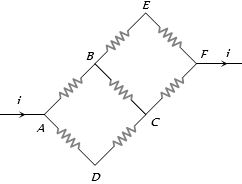
In the adjoining circuit diagram each resistance is of $10$ $\Omega$. The current in the arm $AD$ will be
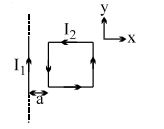
A square loop of side $\lambda $ is placed in the neighbourhood of an infinitely long straight wire carrying a current $I_1.$ The loop carries a current $I_2$ as shown in figure
List$-I$ List$-II$
$UV$ rays $(i)$ Diagnostic tool in medicine
$X-$ rays $(ii)$ Water purification
Microwave $(iii)$ Communication, Radar
Infrared wave $(iv)$ Improving visibility in foggy days

Choose the correct answer from the options given below.